


Less than 24 hours after announcing the blockade, Trump told reporters that "the right people" in Iran had called and "want to work a deal."
Pakistan offered to host a second round of talks.
Oil fell 2.55%. Gold rallied 0.70%. Silver surged 2.87%. The dollar weakened.
If you've been reading these alerts all week, you've seen this movie before.
The TACO Cycle, One More Time
Sunday night: "BLOWN TO HELL." "LOCKED AND LOADED." Blockade announced at 12:43 AM between an AI-generated image of Trump as Jesus and a rendering of Trump Tower on the moon.
Monday morning: oil surges 8% to $104. European gas up 18%. Asian markets fall. IRGC warns "no port in the Gulf will be safe."
Monday afternoon: Trump says Iran called. "They want to work a deal." S&P closes up 1%, erasing all losses since the war began on February 28.
Tuesday morning: oil gives back 2.55%. Gold up. Silver up big. Dollar down. Markets exhale.
This is the seventh iteration of the same pattern since the war began. Extreme threat → panic → signal of retreat → relief rally. The TACO trade ("Trump Always Chickens Out") that Wall Street coined last year is running like clockwork.
The pattern has become so compressed that the full cycle now fits inside 36 hours. It used to take a week.
Did Iran Actually Call?
Trump's claim that "the right people" called deserves scrutiny. Iran's Foreign Ministry hasn't confirmed any call. Iran's President Pezeshkian said yesterday that Tehran "prefers diplomacy" but that Trump's blockade threat "will have wide-ranging consequences for global trade." That's not the language of a country that just called to make a deal. It's the language of a country, leaving the door open while maintaining its position.
Pakistan's role is the key. Pakistan reportedly offered to host a second round. Pakistan's FM Dar described the 21-hour Islamabad session as "intense and constructive" and urged both sides to maintain the "positive spirit." The Iranian delegation stayed behind in Islamabad after Vance left, conferring with Pakistani mediators. So the diplomatic channel is alive, but it's running through Islamabad, not through a direct call to Trump.
My read: Trump is doing what the psychological profile predicts. The episodic man needs to frame each moment as a win. Yesterday's episode was "BLOWN TO HELL." Today's episode is "they called, they want a deal." Both are real to him in the moment he says them. Neither necessarily reflects what's actually happening in the diplomatic back-channels.
The market bought it anyway. The S&P erasing all war losses on a single Trump comment tells you how desperate investors are for good news. The problem is that they might get nothing material despite social media reassurance.
The Blockade's First Test: A Chinese Tanker
The National reported that a US-sanctioned Chinese tanker transited the Strait of Hormuz despite the blockade. If the US Navy stopped it, we would have heard. The silence suggests it passed through unchallenged.
This is the first real-world test of the blockade, and it suggests enforcement will be selective. The CENTCOM operational order targets "all maritime traffic entering and exiting Iranian ports." But stopping a Chinese-flagged vessel creates a direct US-China confrontation that neither side wants right now, especially with Trump already warning China about "big problems" over the air defense intelligence report.
If the blockade doesn't stop Chinese vessels, and China is one of the primary buyers of Iranian oil, then the blockade's economic impact on Iran is substantially reduced. Iran's "untapped leverage" (Rezaee's phrase from yesterday) may include precisely this: the knowledge that the US won't risk a naval incident with China to enforce the blockade.
Three Competing Diplomatic Tracks
The situation has fractured into three separate diplomatic efforts, each with different goals:
Track 1: US-Iran (via Pakistan). Vance's "final and best offer" is on the table. Iran hasn't accepted or rejected it. Pakistan is pushing for a second round, and Pakistan's defense minister claimed "positive progress" with a next round reportedly planned for as soon as April 16. If true, the full TACO cycle (blockade Sunday → resumed talks Wednesday) would complete in 72 hours. The sticking points remain: nuclear enrichment, Strait control, Lebanon, sanctions.
Track 2: France-UK coalition. Macron and Starmer are convening a conference "in the coming days" for a "strictly defensive, peaceful multinational mission" to restore freedom of navigation. This is explicitly separate from the US blockade. The UK said it will contribute to minesweeping but not to the blockade. The EU's Kallas urged a "global coalition" to secure the Strait. This track could take weeks to organize and deploy.
Track 3: China's framework. Xi proposed a four-point Middle East peace plan during meetings with Spain's PM and Abu Dhabi's crown prince. China is positioning itself as an alternative broker, with its own framework based on "peaceful coexistence, national sovereignty, international rule of law." This track is the most embryonic but the most strategically significant. If China becomes the mediator, the terms will look very different from what Vance offered in Islamabad.
There's also a Track 4: Israel-Lebanon, with Rubio participating in talks between Israeli and Lebanese ambassadors in Washington tomorrow. If Lebanon gets a separate ceasefire, it removes one of Iran's key demands and potentially simplifies the US-Iran negotiation.
These tracks are not coordinated. They may work at cross-purposes. The France-UK mission explicitly distances itself from the US. China's framework is designed as an alternative to US-led security architecture. The Israel-Lebanon talks could either help or hinder the Iran track depending on the terms.
One thing remains clear: Iran has leverage like never before, and despite the military losses, it seems to be in much stronger position than it was just two months ago.
The CENTCOM Corridor: Why Markets Are Cheering (and Why It's Premature)
Beyond the diplomatic tracks, there's also a military one that I think is driving part of today's relief rally. CENTCOM Admiral Brad Cooper announced that US forces would begin establishing "a new passage" through the Strait and share details with the maritime industry "soon to encourage the free flow of commerce."
This is more than mine-clearing. The US is trying to create an alternative corridor through the Strait that bypasses Iran's controlled routes entirely. If it works, it breaks the toll booth model by giving ships a US-guaranteed passage option. That's what the market seems to be pricing in today.
But the practical challenges are serious, and I think the market is front-running a timeline that doesn't hold up.
There's a historical precedent: Operation Earnest Will (1987-88). During the Iran-Iraq Tanker War, the US Navy escorted Kuwaiti tankers through the Gulf. It worked, but it took months to set up, required constant naval presence, and ships still got hit. The USS Samuel B. Roberts struck an Iranian mine in April 1988, leading to Operation Praying Mantis, the largest US naval engagement since WWII.
The critical difference: in 1987-88, Iran was simultaneously fighting Iraq and couldn't devote full military attention to the Strait. Today, Iran's entire military focus is on Hormuz. They've had six weeks to fortify positions, lay mines, and deploy assets along both shores.
The Strait is 21 nautical miles at its narrowest. The shipping lanes are two 2-mile corridors separated by a 2-mile buffer. Every inch is within range of Iranian shore-based anti-ship missiles, fast attack boats (the IRGC has hundreds, they can reach any point in minutes), and coastal artillery. You can clear a corridor of mines today, and Iran can re-mine it tonight. Mine clearance while the mining party controls both shores is not a standard minesweeping operation. It's a combat operation.
CENTCOM has the capability. 15 warships, F-35Bs, destroyers with mine-clearing equipment. They can physically do this. But "can" and "quickly" are different questions. A protected corridor would require 24/7 escort operations for every tanker passing through. That's an enormous operational commitment. And every escort mission is a potential flashpoint with IRGC fast boats that have been told to respond with "severe force."
My honest assessment: establishing a US-guaranteed corridor is a months-long project that could eventually succeed, similar to how Earnest Will eventually succeeded. But markets seem to be pricing it as an imminent solution. The first tanker convoy through a US-cleared corridor is weeks away at best. And every transit carries risk of an incident that would shut the corridor down immediately.
Energy Secretary Wright's own timeline: "meaningful ship traffic" is expected "sometime in the next few weeks." That's the administration's best case. Not days. Weeks.
The IEA-World Bank-IMF Warning
The most important institutional statement yesterday came from the joint IEA, World Bank, and IMF warning: "Even after a resumption of regular shipping flows through the Strait, it will take time for global supplies of key commodities to move back towards pre-conflict levels, and fuel and fertilizer prices may remain high for a prolonged period given the damage to infrastructure."
This is the institutional confirmation of what I've been writing in the previous week. The damage is structural. Even a diplomatic breakthrough tomorrow doesn't normalize prices for months. Infrastructure is damaged. Mines are in the water (and some lost). Supply chains are disrupted across oil, LNG, and fertilizer. The Asian Development Bank projects regional growth slowing to 5.1% with inflation rising to 3.6%.
US Energy Secretary Chris Wright said oil will stay high and "maybe even rising" until "meaningful ship traffic" gets through, which he expects "sometime in the next few weeks." That's the administration's own timeline: weeks of elevated prices at a minimum.
Today's Price Action: Channel Break or TACO Noise?
Here are today's prices:
Gold: $4,801, up 0.70% Silver: up 2.87% Oil (WTI): down 2.55% Dollar (DXY): down 0.17% S&P: up 0.14% Nasdaq: up 0.27% Bitcoin: up 1.82% Copper: down 0.80%
This is the mirror image of yesterday. Oil down, gold up, silver up big, dollar weak. Does this break the oil/inflation/USD channel I've been describing?
I don't think so. Here's why:
Every TACO cycle this year has produced a relief rally that faded within 48-72 hours. The ceasefire announcement last Tuesday produced a gold rally and oil crash that reversed by Wednesday afternoon. The tariff pauses earlier this year produced relief rallies that gave way to new highs in the underlying trend within days.
The structural problem hasn't changed since yesterday. The Strait is still at 5-15% capacity. The mines are still in the water. Iran still controls both shores. The blockade, if enforced, makes things worse, not better. I think the market is cheering a combination of three things:
- Trump's "they called" comment
- - the April 16 talks rumor
- - the CENTCOM corridor announcement.
Each one individually is thin. Together they create enough hope for a relief rally, especially when positioning was as short as it was after yesterday's 8% oil surge. But a phone call (real or claimed) doesn't clear a minefield, and as I detailed above, the corridor project is a months-long undertaking even under optimistic assumptions.
The test is simple: if oil continues falling for three or more consecutive sessions and actual vessel traffic through the Strait increases meaningfully (toward 30-40 ships per day), then the channel is breaking and I'll adjust. If oil stabilizes above $90 and traffic stays at current levels, today is noise within the trend, and the channel reasserts.
Silver's 2.87% rally is worth noting separately. Silver is more volatile than gold in both directions, and today's move is a snapback from yesterday's 2.28% decline. The net move over two days is roughly +0.5%. That's noise, not trend change.
What I'm Watching Today
The blockade is now in effect. The rest of the week will show whether it's enforced or performative. Key signals:
- Does the US Navy stop a non-Iranian vessel that paid tolls? If yes, escalation. If no, the blockade is narrower than announced.
- Does Iran retaliate against the blockade? The IRGC said "no port will be safe." If they act on that threat, oil goes back above $110 immediately.
- Does Trump follow through on the "they called" claim with an actual diplomatic step? Or does it fade like previous walk-backs?
- Does the France-UK conference materialize this week? If 40 nations sign up for a minesweeping coalition, that's the first real path to Strait reopening, operating on a timeline of weeks to months.
Our positions remain intact. Today's relief rally doesn't change the structural picture, and the price moves don’t improve the technical one.
The oil/inflation/USD channel has been confirmed by a full week of data. One TACO bounce doesn't override four consecutive sessions of confirmation. I'll adjust if the data changes. So far, it hasn't.
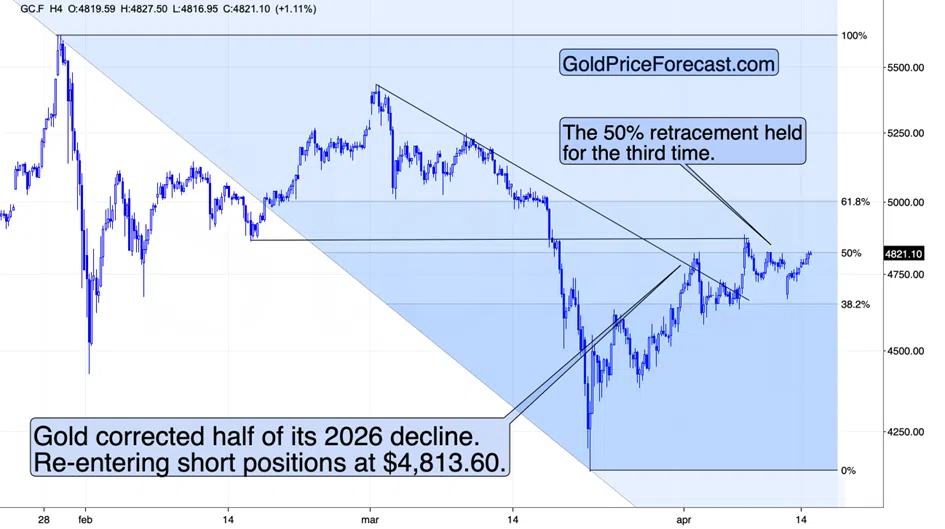
Technically, this is yet another (fourth or fifth, depending on how one counts them) gold’s attempt to move above its 50% retracement.
This resistance – and the mid-Feb low – hold. If they fail… [the analysis continues in the full version of today’s analysis – today’s Gold Trading Alert].
Thank you for reading today’s free article.
Sincerely,
Przemyslaw K. Radomski, CFA