


On Friday, the Supreme Court struck down all IEEPA-based tariffs. Gold surged. The dollar slipped from a one-month high. And nobody knows what happens next.
That's the point. I think we've reached what I'd call Peak Confusion, the moment where policy uncertainty is so total that it can only decrease from here (or increase only modestly).
And decreasing confusion is bearish for gold.
What Happened on Friday
The Supreme Court ruled 6-3 in Learning Resources, Inc. v. Trump that the International Emergency Economic Powers Act (IEEPA) does not authorize tariffs. Chief Justice Roberts wrote that IEEPA contains no reference to tariffs or duties. This single decision invalidated the legal basis for the tariffs that generated roughly $269 billion in revenue through January 2026, and opened the door to an estimated $142-175 billion in potential refund claims (per the Yale Budget Lab).
Within hours, Trump responded by signing a 10% tariff under Section 122 of the Trade Act of 1974. By Saturday, he raised it to 15%, the statutory maximum.
Gold, silver, and mining stocks moved higher in the aftermath.
The dollar's reaction was more muted than headlines suggest. The DXY had actually rallied to a 3.5-week high by Thursday. On Friday, it pulled back only about 0.13%, finishing near 97.8. The more meaningful drop came (briefly) today, when Trump's weekend tariff hike to 15% pushed DXY below 97.5. This is important context: the dollar is roughly in the middle of its recent trading range (it hit an actual four-year low of 95.5 on January 30, then rebounded to near 98 by mid-February). It is NOT at multi-year lows.
On the surface, gold's rally looks bullish.
I think it's the opposite.
Why This Is Peak Confusion
After Friday's ruling, the tariff situation is more confused than it has ever been in modern U.S. history. Consider what's happening simultaneously:
The entire IEEPA tariff framework has been permanently dismantled. The replacement tool (Section 122) has never been used for broad tariff purposes before, and legal scholars are already questioning its validity since the U.S. doesn't have the balance-of-payments deficit that the statute requires. The 15% tariff expires in 150 days (around July 24) without Congressional extension. Congress would need to act during a pre-midterm cycle to extend it. Over $140 billion in refund litigation is now in legal limbo. Europe's trade chief proposed on Sunday suspending ratification of a trade agreement with the U.S. India delayed negotiations to finalize an interim deal. Trading partners don't know which commitments to honor. The Fed doesn't know how to model any of this. The December core PCE data, released the same Friday as the ruling, came in at 3.0% year-over-year (the highest since April 2024, above the 2.9% consensus). The advance Q4 GDP estimate, also released that day, printed at just 1.4% annualized, well below the 2.8% expectation.
That's about as confused as a policy situation gets.
And that's exactly why I think confusion has peaked.
Here's the question I keep coming back to: what's the NEXT thing that makes this MORE confusing? A second Supreme Court ruling? That would bring clarity, not more confusion, even if the outcome is negative. Congress stepping in? Also clarity. A new trade deal framework? Clarity. Even if Section 122 gets struck down too, that's a resolution of uncertainty, not an addition to it.
The 150-day clock on Section 122 is itself a built-in confusion expiration timer. By late July, either Congress acts (clarity) or the tariffs drop back to pre-IEEPA levels (also clarity). Both outcomes reduce uncertainty from current levels.
The Confusion Ceiling Is Capped
There's one structural factor here that I think many gold bulls are missing entirely.
Trump has lost one of his biggest weapons. IEEPA is gone forever for tariff purposes. Section 122 is capped at 15% and expires automatically. He can't escalate beyond where we are right now, even if he wants to. The confusion ceiling is lower than it was a week ago. That's inherently de-escalatory over time.
Before Friday, Trump had an uncapped tariff tool. He could threaten 50%, 100%, 145% on China. That open-ended threat was what kept markets in a state of permanent uncertainty. Now the maximum is 15%, and it comes with a countdown timer.
Gold rallied on the initial shock of the ruling. But shocks fade. And when the dust settles, what's left is a trade policy environment that is structurally LESS uncertain than what we had before, not more.
The USD Factor
The DXY near 97.5 remains weak relative to where it was a year ago (down about 8.5% over 12 months). But it has been recovering from its January 30 low of 95.5, and the fundamental case for USD support hasn't changed: tariffs (even at reduced levels) still affect import demand, still compress trade deficits, and still create mechanical dollar support.
What's changed is that Trump's tariff toolkit has been reduced. That's a constraint on his ability to generate policy chaos, which is, paradoxically, USD-positive over time. Less policy uncertainty ahead means less reason for foreign investors to avoid dollar-denominated assets.
Meanwhile, core PCE at 3.0% reinforces the case that the Fed will hold rates restrictive for longer. Atlanta Fed President Bostic said on Friday that it's prudent to keep interest rates mildly restrictive. That rate support limits the USD downside.
The Bigger Picture
Gold near $5,138 is still about 8% below its all-time high of roughly $5,589, set on January 28. It hasn't retested those highs despite what should have been one of the most gold-bullish events imaginable (a Supreme Court decision creating total trade policy chaos). That non-confirmation matters.
The consensus among major banks is bullish on gold. Goldman Sachs reiterated its year-end target of $5,400 on Friday. When consensus leans this heavily in one direction, it's worth asking who's left to buy. The contrarian setup, while uncomfortable, points the other way.
What I'm Watching This Week
Three signals will confirm or deny Peak Confusion:
1. Does gold fail to rally on the next piece of bad tariff news? If it stalls near current levels on a new negative headline, that's confirmation.
2. Does the USD hold its recent recovery from the January lows and continue building a base? The 97-98 range is the key zone.
Having said all that, let me now turn to the charts. The full version of today’s analysis (Gold Trading Alert) includes coverage of gold and mining stocks, but in this free article, I’ll focus on silver.
Silver moved sharply higher, but it didn’t move above its very recent short-term high.
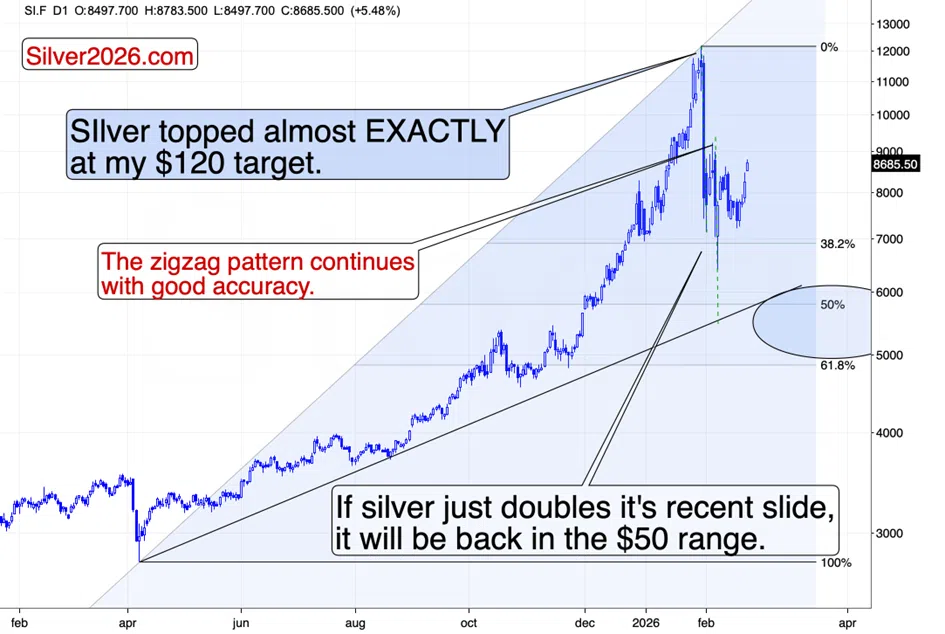
Plus, unlike gold and GDXJ, it didn’t move close to its recent – likely final – high.
Yes, silver’s strength should raise eyebrows right now, but there are three possible explanations for it:
1. As above – peak uncertainty.
2. The upcoming delivery notice for the March contract – if more silver ounces are demanded for delivery than are available – we could see disconnect between physical and paper (futures) price of silver (I’m forecasting that this will eventually happen in my silver book)
3. The regular outperformance of silver that happens just before the end of a given upswing in the precious metals sector.
In my view, I think the first and third point are likely responsible for 80% of the move, and I’d attribute 20% of the rally to the second point – the threat of the COMEX default.
At the same time, please note that stocks are reacting to this chaos with declines – and so does bitcoin.
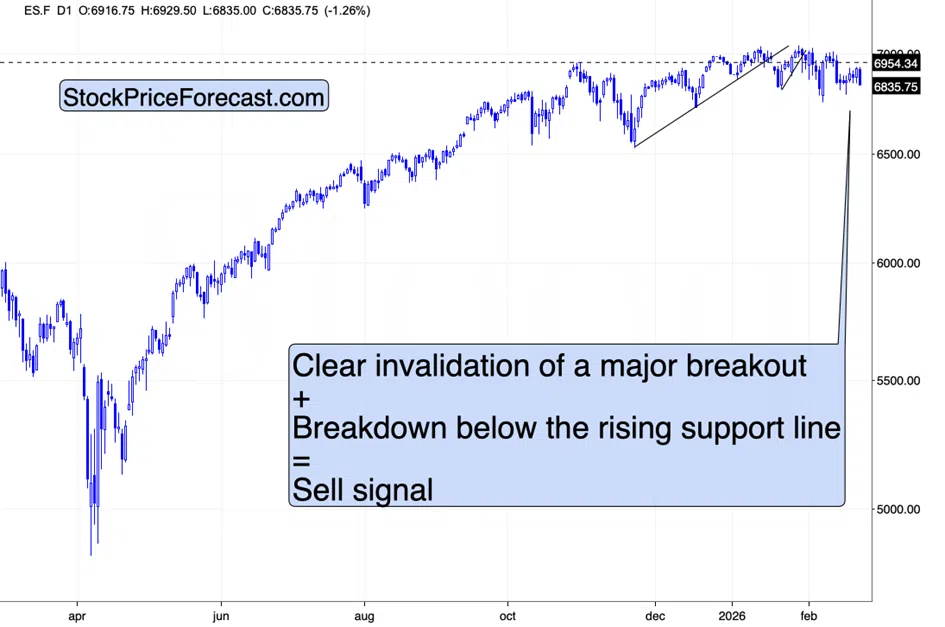
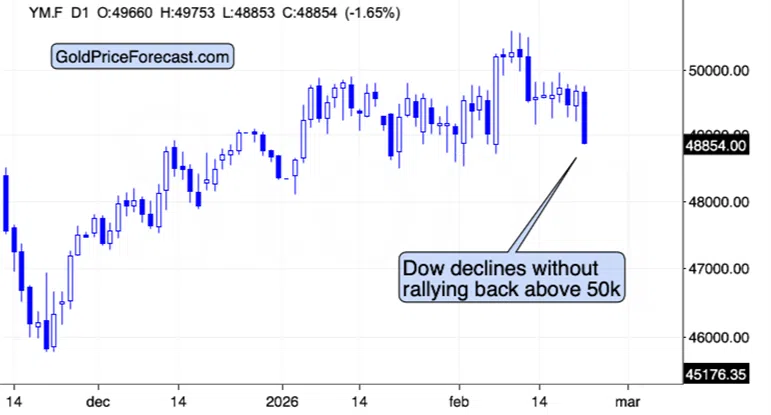
After failing to hold above the all-important 50k level, Dow is declining and it’s very close to being at fresh February lows.
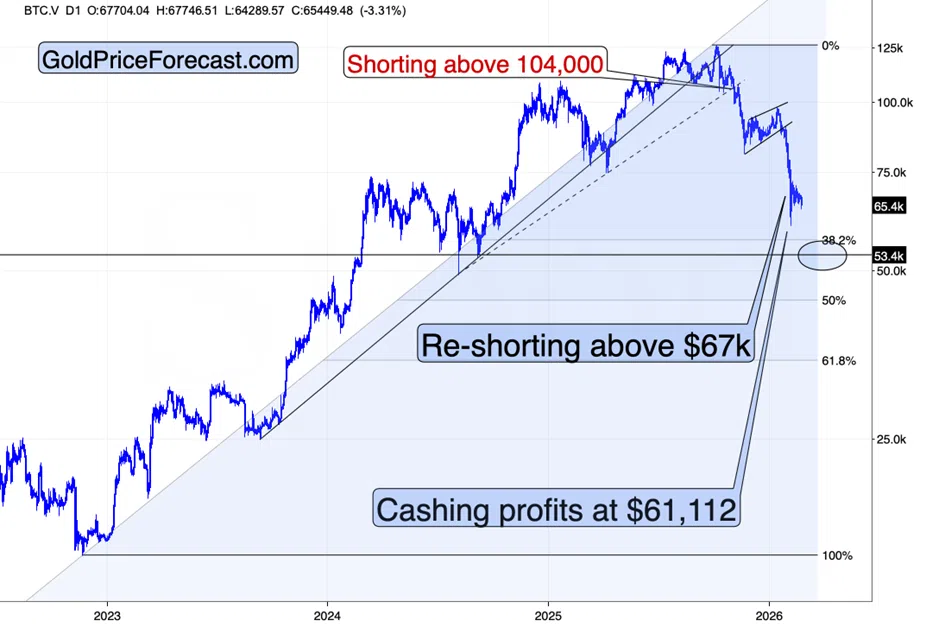
Bitcoin is down by over 3% today and out short positions in it are becoming more profitable. And in my view, there’s much more to come.
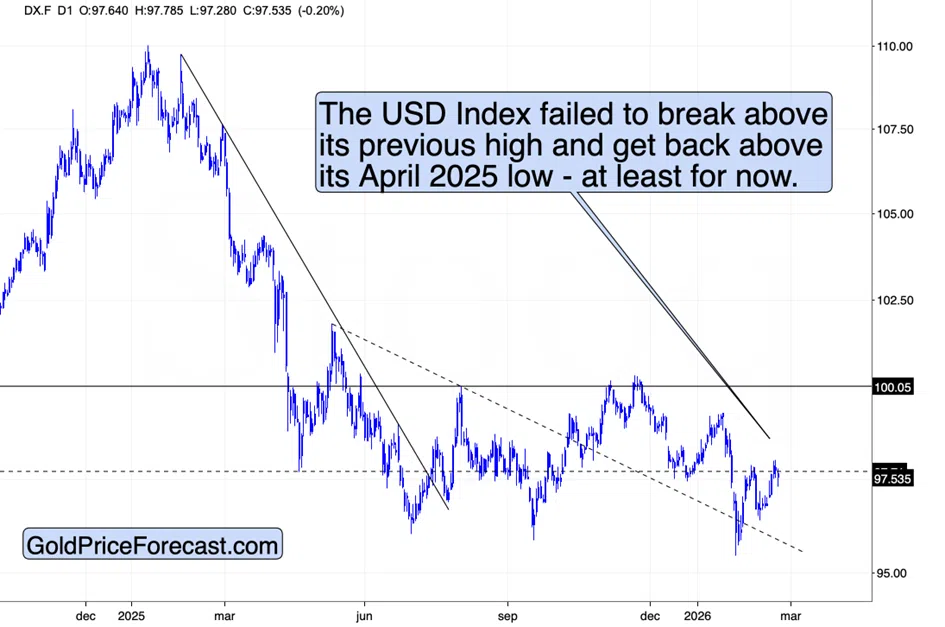
Interestingly, the USD Index is not doing much today. It declined initially, but it’s recovering quite well.
Why is it so strong here? Because it’s been taking a beating for a year, and it looks like everyone who wanted to sell or short it has already done so.
This performance suggests more resilience and higher values in the following months (and quite likely – weeks).
I admit – the moves higher in gold, silver, and mining stocks seem bullish at the first sight.
However:
1. Miners are already reversing their rally.
2. There’s a great single-event explanation for this jump in prices – something that is unlikely to create a bigger uptrend beyond what we already saw.
3. The performance of stocks and the USD Index actually provides the case for lower precious metals values in the following weeks and months.
Thank you for reading my today’s free analysis. I’ll continue to send you occasional updates and, as always, I’ll keep my Gold Trading Alert subscribers informed (also on insurance-, investment-, and trading-capital-based details) at all times.
Thank you.
Przemyslaw K. Radomski, CFA
Founder
Golden Meadow®