


Three US Navy destroyers transited the Strait of Hormuz yesterday evening. Iran fired missiles, drones, and sent small boats to attack them.
The US struck back, hitting three Iranian ports: Bandar Abbas, Qeshm, and Bandar Kargan. CENTCOM said it targeted missile launch sites, command and control locations, and intelligence nodes. No US assets were struck.
Trump called it "just a love tap."
He confirmed the ceasefire is "still in effect." Then on Truth Social: "just like we knocked them out again today, we'll knock them out a lot harder, and a lot more violently, in the future, if they don't get their Deal signed, FAST!" He later told reporters that without a deal, there will be "one big glow coming out of Iran."
That's sounds like a nuclear threat. During a ceasefire. On the same day, US and Iranian forces fired at each other. And gold is barely moving.
Day 69 of the war.
Technically Speaking
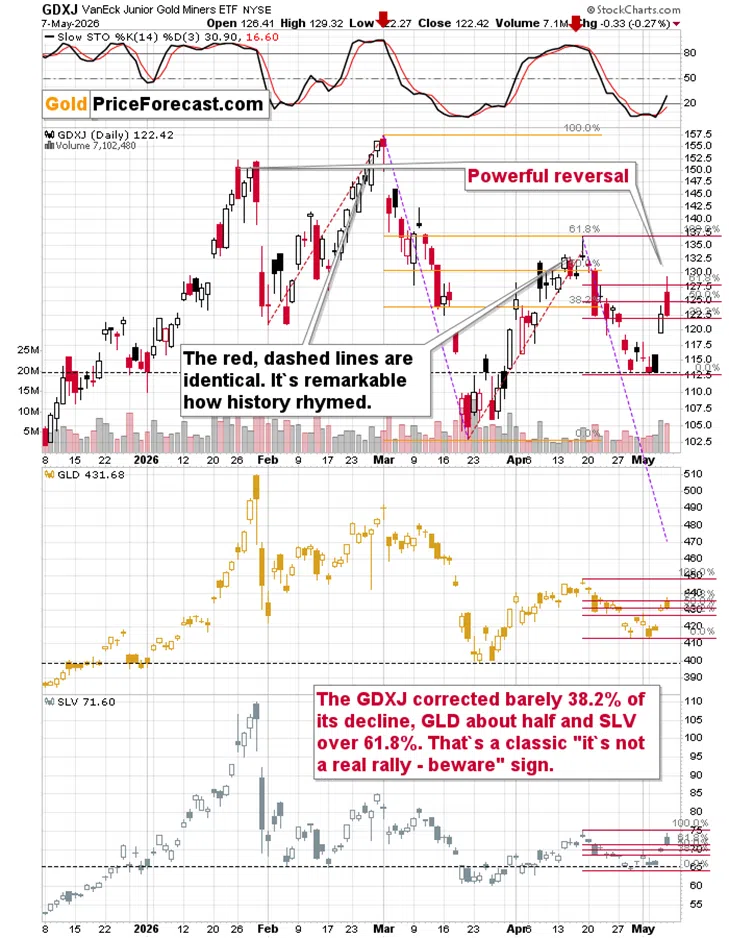
I previously wrote that $123 was possible as the upside target, and we didn’t get further than that in terms of the daily closing prices.
Most interestingly, though, despite the powerful rally early in the day, the GDXJ ended yesterday’s session in the red, creating a powerful shooting star reversal candlestick. It formed at a relatively big volume, which means that it should not be ignored.
Please also consider the relative valuations. The GDXJ closed approximately at the 38.2% Fibonacci retracement based on the recent decline. GLD closed approximately at the 50% retracement, and SLV closed above the 61.8% retracement.
Silver is outperforming gold on a very short-term basis, while mining stocks are underperforming. This is exactly the kind of combination that precedes declines in the precious metals market.
Is the rally over? That seems to be the likely situation. We could see the market revisit the previous high only to decline once again – something like what we saw at the January top – but beyond that, I think the rally is done.
This is not based on gold technical analysis alone, and you will find some of the details below.
The Fiction and the Reality
The ceasefire exists on paper. In practice, the US struck Iranian ports yesterday. Iran fired missiles at US destroyers. The US sank Iranian boats. Iran claims the US hit an Iranian tanker near Jask first. Both sides say the other started it. Both sides say the ceasefire continues.
This pattern has been consistent for weeks: the label "ceasefire" persists while the military activity intensifies. Ships seized, drones launched, ports bombed, boats sunk. The diplomatic fiction serves both sides. Trump doesn't want to admit the ceasefire failed because that would mean restarting a war with 34% approval and $4.56 gas. Iran doesn't want to admit it because the ceasefire gives it time to negotiate while maintaining Strait control.
For markets: the ceasefire label doesn't matter. What matters is whether the Strait is open. It isn't. Yesterday's transit of three US destroyers under fire reinforced the point: the Strait remains a combat zone regardless of what anyone calls it.
Why Project Freedom Really Paused (It Wasn't "Great Progress")
On Tuesday, I wrote that Trump paused Project Freedom citing "great progress" toward a deal. That was Trump's stated reason. The real reason, revealed by NBC News on Wednesday, is different and more important.
Saudi Arabia suspended US military access to Prince Sultan Airbase and Saudi airspace after Trump launched Project Freedom via social media on Sunday without consulting Riyadh. Kuwait also cut off overflight access. Without Saudi airspace and bases, the US couldn't provide the "defensive umbrella" of fighter jets, refueling tankers, and support aircraft that Project Freedom required.
The reasons Saudi Arabia acted are telling. First, Trump blindsided MBS with a social media announcement. Saudi leadership learned about Project Freedom from Truth Social, not from a phone call. Second, when Iran attacked the UAE on Monday (19 projectiles, Fujairah oil zone fire), senior US officials downplayed the Gulf attacks. Saudi Arabia feared that if they were similarly targeted, the US wouldn't protect them either.
So MBS called Trump, conveyed his concerns, and informed him the bases and airspace were closed. Trump paused Project Freedom within hours. The "great progress" framing was face-saving.
This matters for two reasons.
First, it reveals a structural constraint on US escalation. The US cannot run air operations over the Strait without Saudi airspace. If MBS objects to a military operation, he can effectively veto it. That gives Saudi Arabia leverage over Trump that didn't exist before the war. And Saudi Arabia's priority is not reopening the Strait through force. It's a diplomatic resolution that doesn't provoke further Iranian attacks on Gulf infrastructure.
Second, it changes the calculation for Project Freedom 2.0. Saudi Arabia and Kuwait have now lifted the restrictions after a second Trump-MBS call. The Pentagon says the operation could restart "as early as this week." But the precedent is set. If Project Freedom 2.0 triggers another Iranian attack on the Gulf (as the first one did), Saudi Arabia can shut it down again. The operation is conditional on Saudi tolerance, not just US capability.
Project Freedom 2.0 and What It Means for Markets
The US is now looking to restart Project Freedom with Saudi and Kuwaiti cooperation restored. If it launches this week, we're back to the scenario from Monday: US destroyers escorting ships, Iran firing at them, oil surging, the channel accelerating.
Yesterday's "love tap" exchange is a preview. Three destroyers went through. Iran attacked. The US struck Iranian ports. Trump declared victory. Iran declared victory. Nothing was resolved. The Strait didn't reopen for commercial traffic. Four ships per day versus 120+ pre-war.
Each cycle of Project Freedom produces the same result: a tactical demonstration that the US Navy can transit under fire, followed by Iran demonstrating it can make the transit costly, followed by commercial shipping staying in port because no insurance company will cover vessels transiting a waterway where missiles are being fired.
Retired Lt. Gen. Gibson's assessment from Monday still holds: "Iran just needs to continue to present a perception of risk to keep merchant traffic to small numbers, essentially keeping Hormuz all but closed. Commercial confidence is really the center of gravity." Yesterday's exchange of fire did nothing to restore commercial confidence. It destroyed more of it.
For gold: the pattern from Monday should repeat. If Project Freedom 2.0 launches, oil surges on escalation fears. The channel operates: oil up → inflation expectations rise → rate-cut expectations die → dollar strengthens → gold pressured. Yesterday's "love tap" produced exactly this dynamic. Gold didn't rally on US-Iran exchanging fire. It barely moved. The thesis holds.
Does BOJ Intervention Change Anything for Gold?
A reader asked whether the Bank of Japan's yen intervention is propping up stocks and undermining the bearish precious metals thesis by weakening the dollar. It's a fair question and worth addressing in detail.
The short answer: no. Yen intervention doesn't change the oil/inflation/Fed channel that drives gold. Here's why.
The US Dollar Index (DXY) is weighted roughly 57.6% euro, 13.6% Japanese yen, 11.9% British pound, 9.1% Canadian dollar, 4.2% Swedish krona, and 3.6% Swiss franc. The yen is only the second-largest component at 13.6%. Even a significant yen move has limited impact on the broad dollar.
When the BOJ or Ministry of Finance intervenes to strengthen the yen (by selling USD reserves to buy yen), it pushes USD/JPY lower. That creates a modest headwind for DXY. But modest is the key word. A 5% yen appreciation only moves DXY by roughly 0.7% (13.6% weight × 5%). The euro, at 57.6% weight, drives DXY four times more than the yen does.
The historical record is clear on intervention's effectiveness. In September-October 2022, Japan spent approximately ¥9.2 trillion ($60+ billion) intervening. USD/JPY dropped from 152 to 146. Within weeks, it was back above 150. In April-July 2024, Japan intervened again, spending roughly ¥5.5 trillion. The yen strengthened temporarily, then weakened again. Both episodes slowed the move without reversing it.
The academic and practitioner consensus: FX intervention without supportive monetary policy (rate hikes) doesn't work beyond the short term. The BOJ has been gradually raising rates under Governor Ueda, which provides more durable yen support than spot intervention alone. But the BOJ's rate path (currently around 0.5%) is still far below the Fed's 3.50-3.75%. That rate differential is the fundamental driver of USD/JPY, not intervention.
Now to the subscriber's specific question: is yen intervention helping the stock market rally by creating an illusion that "all is well"? There's a kernel of truth here. When the dollar weakens (even modestly from yen intervention), it eases financial conditions slightly. Dollar-denominated debt becomes cheaper to service. Emerging market currencies strengthen. That creates a mild tailwind for risk assets.
But the US stock market rally in recent weeks is driven by much larger forces: the TACO pattern (buy the panic, sell the relief), AI capex announcements from Big Tech, and the narrative that the Iran war will end soon. These factors dwarf the effect of yen intervention on DXY. The S&P 500 doesn't rally 5% because the yen strengthened 3%.
The bearish case for precious metals rests on the oil/inflation/Fed channel. Oil elevated → inflation sticky → Fed frozen (or hiking) → dollar supported → gold pressured. None of those inputs are affected by what the BOJ does with the yen. Japan can buy all the yen it wants. It won't reduce oil prices, lower US core PCE from 4.3%, convince the Fed to cut rates, or reopen the Strait of Hormuz.
If anything, yen intervention is a sign of stress, not stability. Central banks intervene when they're uncomfortable with market moves. The BOJ intervening to support the yen means the yen was too weak for comfort, which means carry-trade dynamics and rate differentials are powerful. Those same dynamics support the dollar. The intervention is a symptom of the forces that support our thesis, not a counter-argument to it.
The reader is right that it creates temporary comfort in equities. But temporary comfort in equities during structural macro deterioration is precisely the setup that precedes declines. The 2007 S&P 500 made new highs while the housing market was already cracking (I’ll add more on that shortly). Stocks can feel fine right up until the moment they don't. BOJ intervention doesn't change that timeline. It’s a noise layered on top of signal.
The analysis continues in its premium version, with clear profit-take levels for all featured trades. Interested? Get details in today’s Gold Trading Alert now.
Thank you.
Sincerely,
Przemyslaw K. Radomski, CFA