


Yesterday's Fed meeting was the most important one for gold in months.
Not because of the rate decision (hold at 3.50-3.75%, as expected), but because of what happened around it.
Four FOMC members dissented. That's the most since October 1992. And the split reveals something the market hasn't fully absorbed: the new Fed chair Trump is installing to deliver rate cuts almost certainly won't be able to deliver them.
Let me explain why this matters for gold.
How the Fed Actually Works
The Federal Open Market Committee has 12 voting members: seven governors on the Board of Governors, the president of the New York Fed, and four rotating regional Fed presidents. Rate decisions are made by a simple majority. The chair controls the agenda and runs the meetings, but has exactly one vote out of twelve. The chair's real power is persuasion, not authority.
Yesterday's 8-4 split broke down like this:
Eight voted to hold rates and keep the easing bias (language suggesting future cuts are possible): Powell, Williams (NY Fed), Barr, Bowman, Cook, Jefferson, Paulson, and Waller.
One dissented in favor of a 25bp cut: Stephen Miran, the Trump-appointed governor who has pushed for lower rates at every meeting since joining.
Three dissented against the easing bias: Beth Hammack (Cleveland), Neel Kashkari (Minneapolis), and Lorie Logan (Dallas). They voted to hold rates but wanted the statement to remove any suggestion that future cuts are coming. They wanted to slam the door shut on rate cuts entirely.
As Powell put it in the press conference: "There was a difference over whether to do it at this meeting at which all but one of us agreed that the rate decision was correct, which was not to move."
Why Warsh Can't Cut
Kevin Warsh cleared the Senate Banking Committee yesterday on a party-line vote. He's expected to be confirmed by the full Senate the week of May 11. Trump nominated him because he expects rate cuts. Warsh has floated "preemptive cuts in anticipation of AI-driven disinflation." Trump has called for rates as low as 1%.
Here's the problem. Warsh replaces Miran's seat, not Powell's. Powell announced he will stay on the Board of Governors "for an undetermined period of time," blocking Trump from filling his seat with another dove. ClearBridge's Josh Jamner stated the implication clearly: "The addition of Kevin Warsh to the FOMC will not swing the balance between doves and hawks, as Warsh will take Stephen Miran's seat, given Powell's seat will not be open for the time being."
So, the net balance doesn't change. One dove (Miran) leaves. One dove (Warsh) arrives. Powell stays. The three hawks (Hammack, Kashkari, Logan) who just demonstrated they oppose even mentioning future cuts remain on the committee.
To cut rates, Warsh needs 7 of 12 votes. Yesterday, only 2 of 12 wanted to cut or lean toward cutting (Miran explicitly, and arguably Warsh would have if he'd been voting). Three actively opposed even the language suggesting cuts might happen someday. The remaining seven held the middle ground: no cuts now, but keep the door open.
Claudia Sahm, chief economist at New Century Advisors and creator of the Sahm Rule recession indicator, said it directly: rate cuts are "completely off the table." Employ America's Skanda Amarnath went further: "The facts of the matter have moved decisively in the hawkish direction." He argued the committee should be debating hikes, not cuts.
Christopher Hodge, chief US economist at Natixis CIB, delivered the line that captures it: "Warsh is in the unfortunate position, through no fault of his own, to probably be the least influential Fed chair in a long time. He's going to have a really hard time convincing the other members to cut rates quickly."
Renaissance Macro's Neil Dutta put it simply: "The power of the FOMC Chair is the power of persuasion."
Warsh walks into a committee where three regional presidents just publicly opposed easing, the former chair is sitting on the board blocking his agenda, inflation is above target, and oil is near $120. He has the title. He most likely doesn't have the votes.
What This Means for Gold
Trump gets his chair but doesn't get his cuts. That's the worst outcome for gold.
If Trump had kept Powell, the market would price in continued data-dependent hawkishness. If Warsh could actually deliver cuts, gold would rally on looser monetary policy. Instead, gold gets a dovish chair who can't deliver dovishness, surrounded by hawks who will block him. The market will figure this out quickly. Rate-cut expectations for 2026 are already fading: traders now see a 9.1% chance of a rate HIKE by December (up from 0% before the meeting).
The FOMC statement itself reinforced the channel: "Inflation is elevated, in part reflecting the recent increase in global energy prices." And: "Developments in the Middle East are contributing to a high level of uncertainty about the economic outlook." Oil-driven inflation is now in the Fed's official language. The committee acknowledged the mechanism we've been tracking for weeks: oil → inflation → Fed frozen.
Powell's press conference added context. He called the Iran war one of four supply shocks during his tenure (pandemic, Ukraine, tariffs, Iran), and said: "Every supply shock has the capability of driving inflation up and unemployment up, and the central bank has a really hard time knowing what to do." That's stagflation, described by the outgoing chair.
Today's Corrective Moves
Gold is bouncing today. Oil is pulling back. These are corrective moves after yesterday's massive swings.
Yesterday, Brent surged roughly 7% to close at $118.03 and briefly touched $126.41 overnight (the highest since June 2022). WTI jumped nearly 7% to $106.88. Gold hit a one-month low. These were large, fast moves.
Today's reversal (gold higher, oil lower, dollar weaker) is the channel operating in reverse on a daily basis, as it did on April 17 when the Strait briefly reopened. The direction on any given day can flip. The structural drivers haven't changed: the Strait is closed, the blockade continues, Iran says it will "never" relinquish control over Hormuz, and the Fed just told you it can't cut rates because of oil-driven inflation.
The War: Going Nowhere
Briefly on Iran: the situation confirms the frozen conflict thesis. Trump told Axios he won't lift the blockade until Iran agrees to a nuclear deal. "They are choking like a stuffed pig." CENTCOM's Cooper said 42 vessels have been redirected, with 41 tankers holding 69 million barrels worth $6 billion that Iran can't sell.
Ghalibaf mocked the blockade on X: "3 days in, no well exploded. We could extend to 30 and livestream the well here." Bessent fired back: "We are freezing their retirement funds. Same with their villas in the south of France."
Neither side is moving. The Strait stays closed. The blockade continues.
The Lebanon ceasefire (extended 3 weeks to roughly May 14) is already fraying. Israel killed 9 people in southern Lebanon today. Israeli evacuation orders cover 16 Lebanese towns. Hezbollah's Qassem called the talks "a grave sin" and rejected any disarmament. Lebanon's president called Qassem's position "treason." If the Lebanon ceasefire collapses, Iran has the stated justification to escalate in the Strait.
But that's a story for May. Today's story is the Fed telling you, through an 8-4 split and hawkish language about oil-driven inflation, that rate cuts are off the table for 2026. Gold's structural headwinds are now confirmed by the institution that controls them.
Technicals Confirm: It’s a Pause – Nothing More
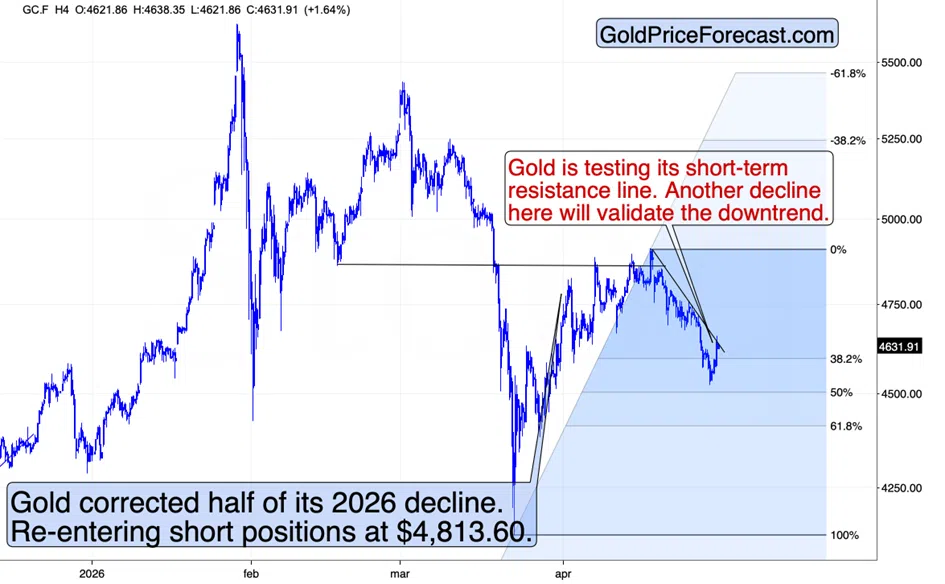
The only bullish thing that gold managed to do today is that it moved slightly above its declining, short-term resistance line. And that was bullish for good 4 hours, because that’s how long it stayed above this line. The breakout was then invalidated, and the bearish outlook remains intact, even from the short-term point of view.
The confirmation comes from the gold-USD link.
Namely, the USD’s correction was much more significant than what we’ve seen in gold.
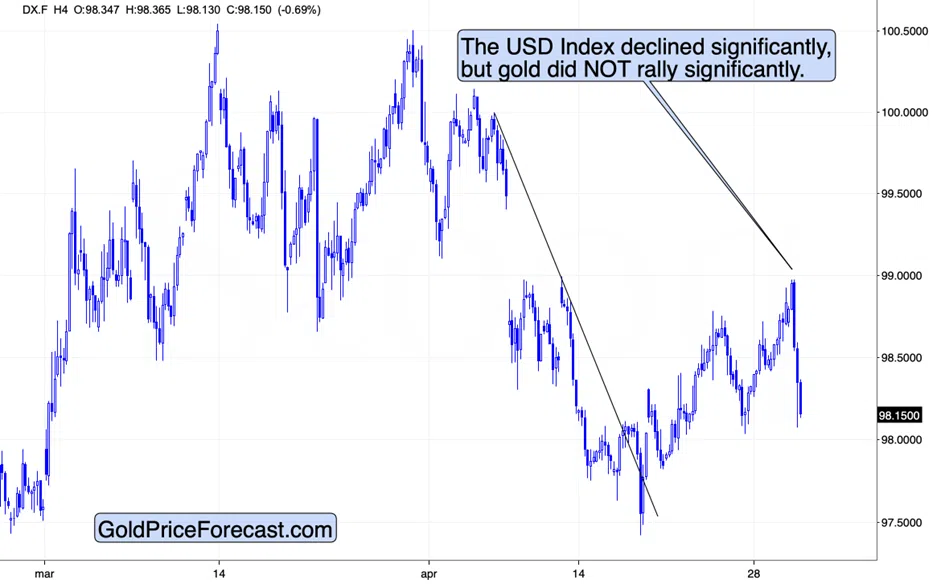
The USD Index erased about half of its late-April rally. Did gold erase about half of its late-April decline? Not even close.
This tells us that gold doesn’t want to rally here – it wants to slide further.
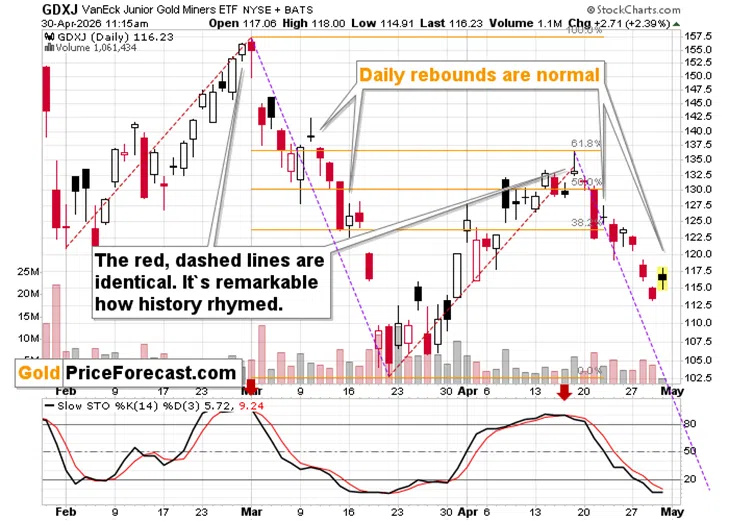
The daily rebound in the GDXJ is perfectly normal. We saw similar and even bigger rebounds previously. Given the position of the Stochastic indicator and given how far we are into this decline, it seems that we might be in a situation that’s similar to the mid-March rebound. That was right before the GDXJ plunged below $105.
FCX is even weaker.
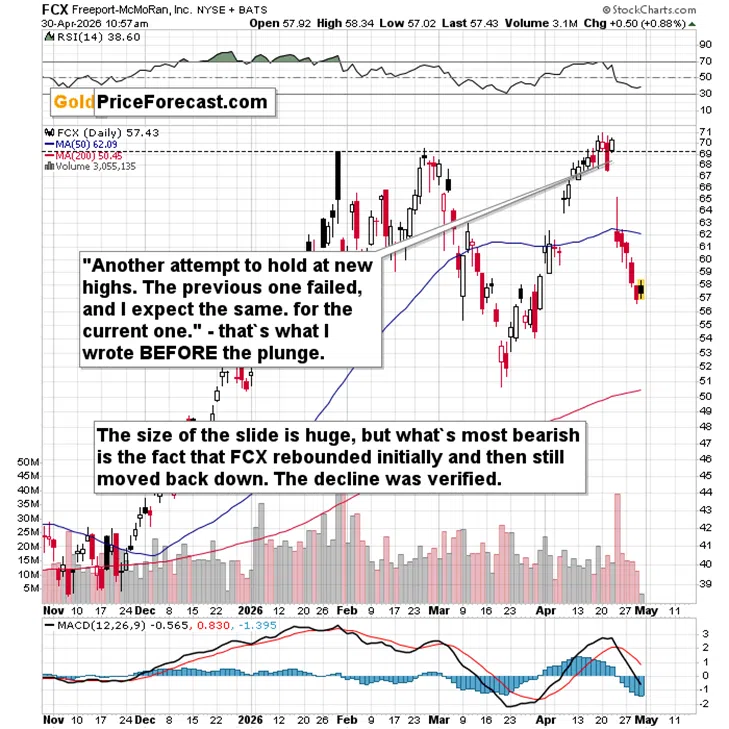
The rebound is barely visible, and this is also in tune with what we saw in mid-March. In fact, the FCX is trading almost exactly at the same price level.
It seems that the profits on my subscribers’ short positions are going to increase much more before this is all over. I’ll keep my subscribers informed on when to take profits via regular and intraday Alerts.
Thank you for reading today's article – the free version of today's Gold Trading Alert (in which the analysis continues). Subscribers receive the full analysis with charts, technical levels, and trading positions daily. Gold Trading Alerts are available directly and through the Diamond Package.
Thank you.
Sincerely,
Przemyslaw K. Radomski, CFA