


As you may know, I’m not posting Gold Trading Alerts when the markets are closed in the U.S., but the current situation seems to demand it.
And I also decided to share this issue (except the position details) with my free readers on the platform.
Given all the threats regarding Greenland and the vision of military conflict between USA and EU, I want to tell you where I think things are going.
Yes, I will feature the charts, but before that, I would like to comment on the more material side of market movements and what drives them. Before I start, I want to emphasize what is the key thing that I find most important while making any geopolitical forecasts right now: it’s Donald Trump’s psychological profile. I’ve done research on this and… I regret not doing it much earlier.
This is profound, because while I (and many others) have been trying to align technical forecasts with those of Trump’s strategy… It seems that there might be no big strategy behind most events and threats after all.
Gold has surged to record highs above $4,689 per ounce. Silver broke $94. Stock futures are declining globally, with S&P 500 futures down about 1%. The Greenland crisis dominates headlines, with Trump imposing 10% tariffs on eight NATO allies until Denmark agrees to sell territory it doesn't fully control. Markets are pricing maximum chaos.
I've seen this movie before (and so did you). And I think I know how it ends.
The "Episodic Man" Framework
Before diving into the current situation, I want to be clear about my analytical approach. I'm not making political judgments here. Many subscribers may have voted for Trump. Many may support his policies. That's not relevant to this analysis.
What is relevant is that Trump has written extensively about his negotiation philosophy, and his behavior consistently follows patterns he documented decades ago. For investors, this creates a predictive framework. The psychology isn't about criticism. It's about anticipation.
Dan McAdams of Northwestern University conducted the most comprehensive scholarly analysis of Trump's psychology. His central finding is striking: Trump "lives in the emotionally vivid moment (episode), fighting to win each moment, moment by discrete moment. The episodes do not add up; they do not form a narrative arc in his mind."
McAdams describes Trump as "the episodic man, living outside of time in the eternal moment." He is "not introspective, retrospective, or prospective. He does not go deep into his mind; he does not travel back to the past; he does not project far into the future."
This framework explains something that has puzzled many analysts (myself included): the apparent lack of strategic consistency. Trump's positions shift because each day is a new episode to be won. Yesterday's threats don't necessarily connect to today's actions. There may be no grand strategy because his psychology doesn't operate that way.
For market forecasting, this is actually useful information. It means we shouldn't expect strategic consistency. We should expect pattern consistency instead.
Trump's Documented Negotiation Patterns
In The Art of the Deal, Trump wrote: "My style of deal-making is quite simple and straightforward. I aim very high, and then I just keep pushing and pushing to get what I'm after. Sometimes I settle for less than I sought, but in most cases, I still end up with what I want."
This single quote explains more about current market dynamics than any economic model. Trump's extreme opening positions aren't meant to be achieved. They're meant to shift the anchor of negotiations so dramatically that any counteroffer appears reasonable by comparison.
Psychologists call this the "Door in the Face" technique. You ask for something outrageous, get refused, then settle for what you actually wanted all along. The other party feels they've "won" by refusing the extreme demand, while you achieve your real objective.
Demanding to purchase Greenland fits this pattern perfectly.
In Never Give Up (2008), Trump advised: "To speed up negotiations, be indifferent. That way you'll find out if the other side is eager to proceed." His willingness to appear willing to walk away, or in this case to appear willing to rupture NATO, creates what negotiation scholars call "walk-away power."
But walking away was never the goal. The goal is extracting concessions.
The confrontational dimension is equally explicit. In Think Big and Kick Ass (2007), he stated: "My motto is: Always get even. When somebody screws you, screw them back in spades." He expanded on this in a 2012 speech: "If somebody hits you, you've got to hit'em back five times harder than they ever thought possible."
This explains the escalation pattern. But it doesn't mean escalation continues forever. It means escalation continues until Trump feels he's demonstrated dominance. Then he pivots to claiming victory.
The China 2025 Parallel Is Almost Exact
Remember the China tariff escalation from early 2025? Let me walk through the timeline:
· Extreme opening: Tariffs reached 145% at peak
· Maximum rhetoric: Both sides declared they would never back down
· Market panic: Stocks crashed, gold surged, recession fears dominated
· Eventual resolution: Tariffs reduced to 30% with framework agreements
· Victory declaration: Trump claimed success despite getting far less than demanded
The Greenland situation follows the identical structure:
· Extreme opening: Demanding territorial acquisition from an ally
· Maximum rhetoric: Trump says he's "100 percent" committed
· Market panic: Gold at record highs, stock futures declining globally
· Resolution: (pending)
· Victory declaration: (pending)
The pattern I've documented as the "TACO trade" (Trump Always Chickens Out) has held through multiple confrontations. Maximum escalation followed by face-saving de-escalation isn't a weakness in Trump's framework. It's the strategy working as designed.
From his own writings: "Sometimes I settle for less than I sought, but in most cases, I still end up with what I want."
The key insight from the "episodic man" framework is that Trump doesn't need to maintain strategic consistency. He needs to win today's episode. Tomorrow is a different episode entirely.
The Nobel Prize Comment Reveals Everything
This is where the analysis gets interesting.
In his letter to Norwegian Prime Minister Jonas Gahr Støre announcing the tariffs, Trump wrote: "Considering your Country decided not to give me the Nobel Peace Prize for having stopped 8 Wars PLUS, I no longer feel an obligation to think purely of Peace."
This sentence is extraordinarily revealing. It tells us:
1. The grievance is personal, not strategic. Trump isn't primarily concerned about Arctic security or rare earth minerals. He feels disrespected by Europeans who haven't adequately recognized his achievements.
2. The real demand isn't territorial. You cannot actually acquire Greenland through tariffs. Denmark doesn't fully control Greenland's sovereignty. Greenland's Premier has explicitly chosen Denmark. The stated objective is legally impossible.
3. What Trump actually wants is recognition or other benefits. The Nobel Prize comment, the repeated references to being "appreciated," the framing of European military exercises as personal affronts, all point to the same underlying dynamic.
Those who have worked closely with Trump consistently identify his need for validation as a primary driver. Howard Stern, a longtime friend, observed: "I know something about Donald Trump, he really does want to be loved. He does want people to really love him. That drives him a lot."
Trump himself has been explicit about this need. When asked what he wanted from governors during the COVID pandemic, he stated: "All I want them to do, very simple, I want them to be appreciative." In December 2025, he told an Oval Office meeting: "I really want to be appreciated."
For market purposes, this is good news.
Why? Because wounds to pride can be healed with symbolic gestures. Territorial demands cannot. If Trump actually needed Greenland for strategic purposes, we'd face a protracted crisis. But if he needs Europeans to demonstrate respect and appreciation, there are infinite ways to provide that without transferring sovereignty.
What a Face-Saving Resolution Looks Like
Trump has repeatedly demonstrated skill at reframing outcomes. He could plausibly accept:
· Enhanced security cooperation agreements in the Arctic
· Expanded U.S. military presence commitments in Greenland
· Rare earth mineral access or joint mining ventures
· Framework for "unprecedented strategic partnership"
· Any public statement from European leaders praising his negotiating success
Remember his documented philosophy from The Art of the Deal: "You can create excitement, you can do wonderful promotion and get all kinds of press, and you can throw in a little hyperbole."
Trump doesn't need to actually acquire Greenland. He needs something he can call a win. European leaders, who understand this dynamic, have strong incentives to provide that off-ramp rather than trigger the €93 billion in retaliatory tariffs they've prepared.
The extraordinary EU summit scheduled for January 22 and potential von der Leyen-Trump talks at Davos create natural negotiation venues. The February 1 tariff implementation deadline creates urgency. Both sides have incentives to resolve this quickly.
A Subscriber's Question About Iran Timing
Lennie asked whether it would be wise to close short positions before a potential Iran escalation, then re-enter after the dust settles. I thought this reply was important to everyone, so I’m featuring it here.
This question has intuitive appeal, but I think it focuses on the wrong risk.
First, regarding Iran specifically: Trump appeared to pull back from strike threats around January 15. Oil dropped over 4% that day as traders interpreted his comments as backing away from military action. He reportedly received "assurances" about executions, which gave him a face-saving exit.
This fits the TACO pattern. Maximum threat, then de-escalation with a face-saving claim.
More importantly, we've already tested whether an Iran escalation can sustain gold rallies. In June 2025, the U.S. actually bombed Iran's nuclear facilities (Fordow, Natanz, and Isfahan). That was the most escalatory military action possible short of nuclear war. Gold's response? It declined roughly 2% in the week following Israel's initial strikes.
If actual nuclear facility strikes couldn't sustain gold's safe-haven premium, why would a revolution?
The more relevant question is whether the Greenland crisis represents a genuine regime change for markets or an extended topping process. Current gold levels reflect a substantial safe-haven premium. If the China parallel holds and we see rapid de-escalation, that premium compresses. In other words, the precious metals market can decline.
The Deutsche Bank "Weaponization of Capital" Scenario
I want to address a more sophisticated concern that could challenge the bearish thesis.
George Saravelos, head of FX research at Deutsche Bank, noted that "European countries own $8 trillion of US bonds and equities, almost twice as much as the rest of the world combined." He suggested Europe could weaponize capital flows rather than trade flows.
This is a legitimate tail risk. Federal Reserve analysis demonstrates that eliminating foreign flows would raise 10-year Treasury yields by 150 basis points. Danish pension funds have already begun reducing dollar exposure and repatriating money back home.
If this "sell America" trade cascades across European institutions, it would represent a fundamentally different crisis than trade disputes. Financial system stress supports gold regardless of other dynamics.
However, the weaponization scenario assumes a sustained, existential rupture in the transatlantic alliance. If the Greenland crisis follows the China pattern (resolution within weeks rather than months), institutional investors don't have time to reposition at scale. The Danish pension fund moves remain isolated rather than triggering a cascade.
This is why I'm watching the February 1 deadline so closely. Quick resolution prevents the financial weaponization scenario from developing. Extended confrontation (past February, into March, and beyond) would change my assessment.
For now, I think quick resolution is more likely based on the patterns I've documented. But I'm monitoring the situation closely and will update if evidence suggests otherwise.
The Timeline Suggests Resolution Is Close
Consider the sequence of events:
· January 14: Denmark-U.S. talks fail
· January 17: Trump announces tariffs
· January 18: EU emergency ambassadors meeting
· January 22: Extraordinary EU summit scheduled
· Late January: Davos meetings (potential Trump-von der Leyen talks)
· February 1: Tariffs scheduled to take effect
That's an extremely compressed timeline. European leaders have every incentive to offer Trump a face-saving exit before February 1. Trump has every incentive to claim victory before actually implementing tariffs that would harm American consumers and complicate relationships with allies.
Or he could implement tariffs and then lower or cancel them shortly thereafter.
The political logic points toward resolution. The psychological framework points toward resolution. The historical pattern points toward resolution.
Markets are pricing maximum chaos. I think we're closer to peak chaos than the beginning of a sustained crisis.
Technically Speaking
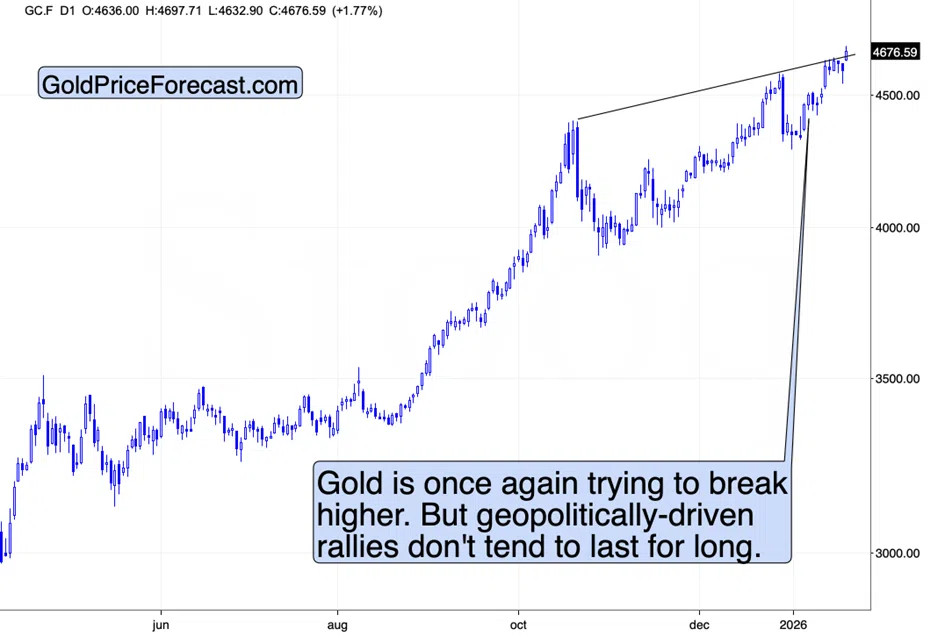
Gold's surge to almost $4,700 is spectacular, but the breakout above the rising resistance line was not confirmed. I think that de-escalation on the political front will align with the technical de-escalation – the invalidation.
The move has been nearly vertical, which historically precedes either consolidation or sharp reversal.
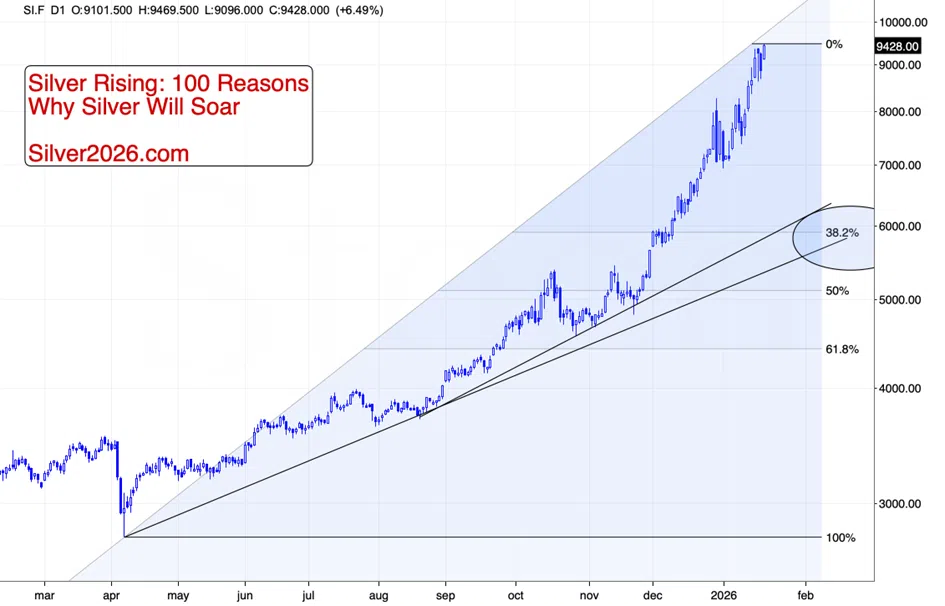
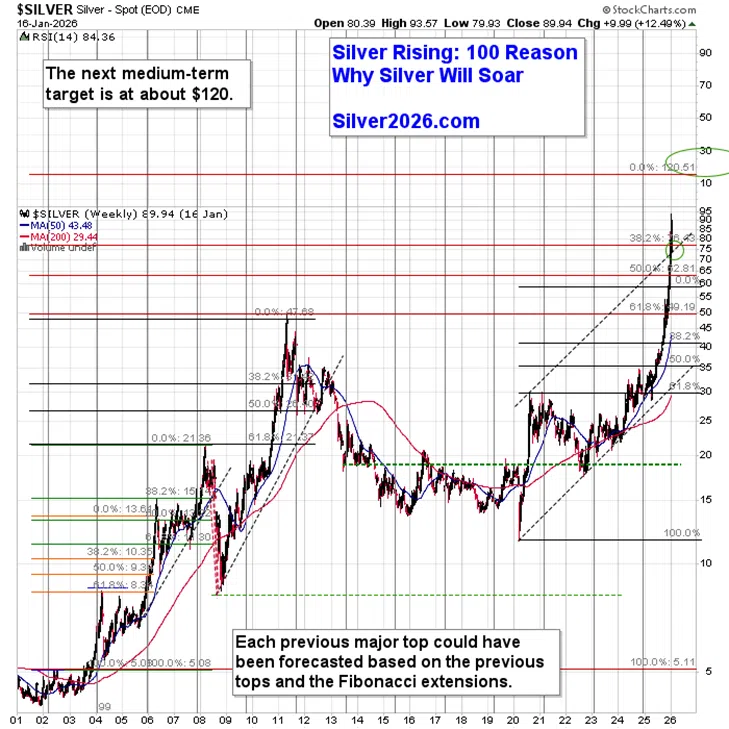
Silver soared to new highs as well – rallying over 6% while gold moved higher by less than 2%. If silver only duplicates today’s rally, it will do what all silver investors dreamt of – it will cross the $100 level.
Can it happen? Yes, it can, and silver can rally even higher – to $120 based on how it soared after previously breaking above the important highs. The momentum is super-strong, and silver’s fundamentals are extremely bullish.
Please note that despite all the talks about Greenland, the USD Index is barely touched.
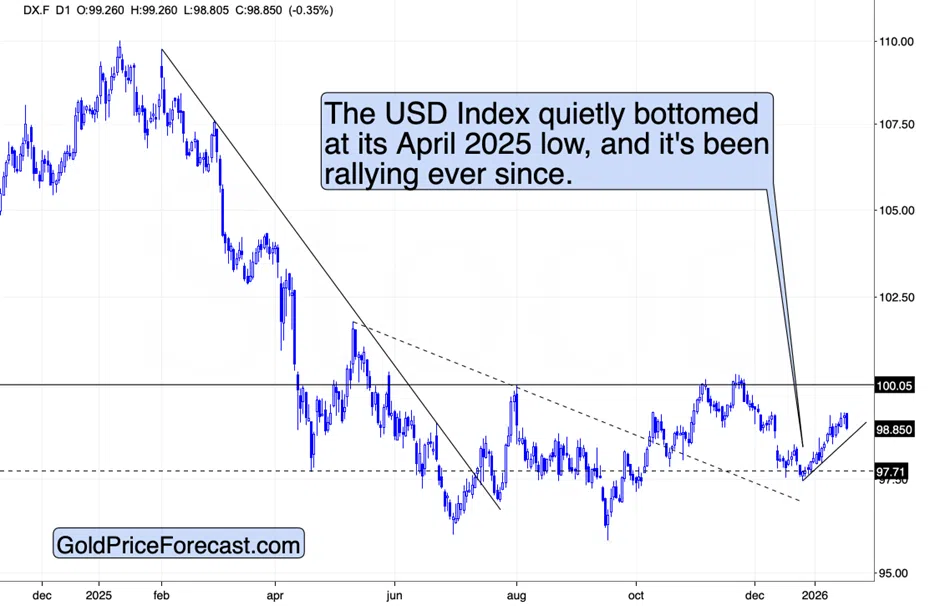
Yes, it did decline today, but this didn’t change even the short-term uptrend.
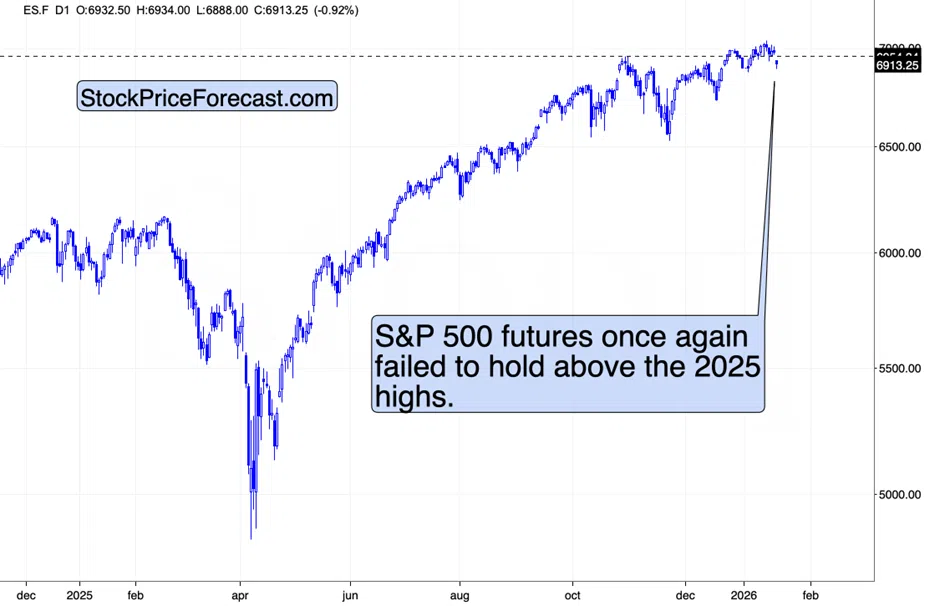
At the same time, the S&P 500 futures just invalidated their breakout above the 2025 high for the second time.
Remember what happened that actually made Trump reconsider tariffs on China? Stocks plunged. It could be the case that history rhymes once again in that regard.
All in all, Trump's Greenland gambit represents maximum leverage application, not actual territorial ambition. The Nobel Prize comment reveals this is fundamentally about perceived European disrespect rather than Arctic strategy. The China 2025 parallel suggests a face-saving resolution before or soon after February 1. Current gold prices include substantial safe-haven premium that compresses when headlines shift from crisis to breakthrough.
Understanding that Trump operates as "the episodic man" helps explain both his behavior and its likely resolution. There may be no grand strategy. There's a pattern of winning episodes. And the pattern includes de-escalation once face-saving opportunities emerge.
I maintain the view that we're in an extended topping process for gold, not a new bull market phase. The current spike represents a crisis premium, not a fundamental revaluation. When the headlines shift from "NATO Crisis" to "Historic Arctic Partnership Agreement," gold will give back these gains quickly.
Consequently, the silver – mining stocks spread continues to make sense in my view. Therefore, I’m not adjusting the positions – neither long positions in silver (investment / insurance), nor short ones in mining stocks (nor bitcoin, which remains profitable).
Thank you for reading today’s free analysis. If enjoyed it and would like to get the premium updates, I encourage you to subscribe to my Gold Trading Alerts today.
Przemyslaw K. Radomski, CFA
Founder
Golden Meadow®