


[This article is exclusive to GoldenMeadow.eu and GoldPriceForecast.com – based on today’s Gold Trading Alert]
The Fed raised rates by 25 basis points to 3.75 to 4.00 percent, unanimously, and 16 of the 18 dots showed at least one more hike this year. The two-year yield rose to its highest in more than two years, the USD Index closed at 100.28, its highest since July 31, and the S&P 500 closed lower on the day of the first hike of a tightening cycle for the first time since 1997.
Gold settled at $4,387.50 half an hour before the decision, fell more than 1 percent after it, and has recovered to about $4,411 this morning. Across the whole event, the metal is roughly where it started. The dollar is not.
What The Fed Said
The statement ran 130 words, the shortest under Warsh, and the sentence that mattered was this one: "Today's policy action will support a timelier return to the Committee's 2 percent goal. The Committee will deliver price stability." The press conference ran 22 minutes. The chairman said inflation "has been too high for too long," that "the plain fact is inflation is too high," and gave three reasons for rising bond yields: economic strength, competition for capital from the capital-spending surge, and geopolitics. Not one of the three was "a supply shock we intend to look through." Markets priced an October hike at about 50 percent by the close.
On Tuesday I wrote that the Fed meets to ratify what the bond market had already done. It did.
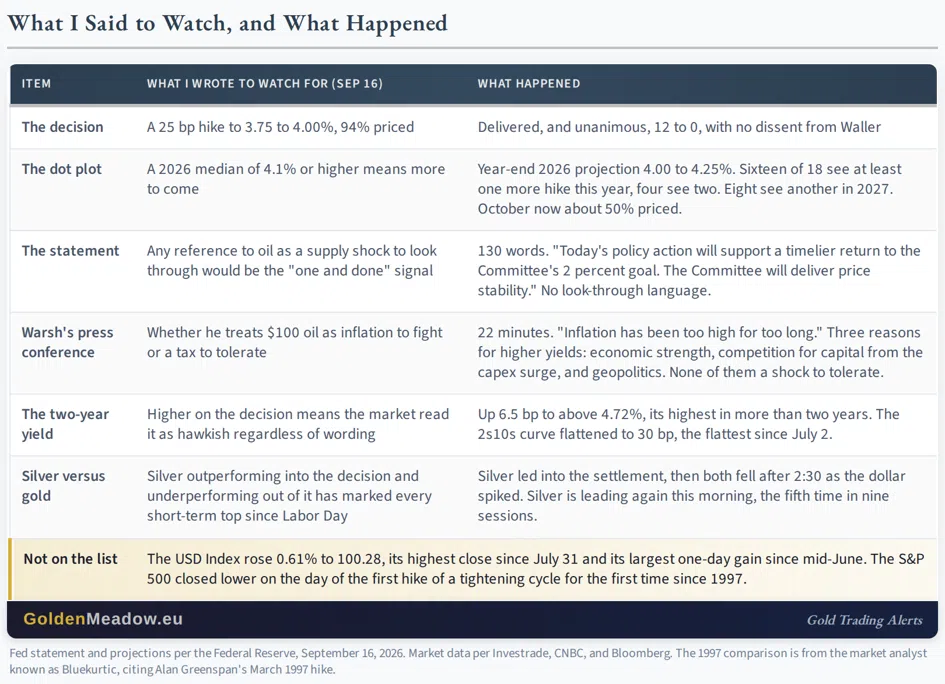
The row that matters most is the one I did not put on yesterday's checklist. The dollar's move was the largest of the day in any market that matters to us.
The Dollar's Double Bottom Delivered
On September 10, I wrote: "It seems that the double-bottom in the USD Index is in, and please note that this is exactly how it bottomed in May below 98. The implications are bullish for the USD Index and bearish for the precious metals sector."
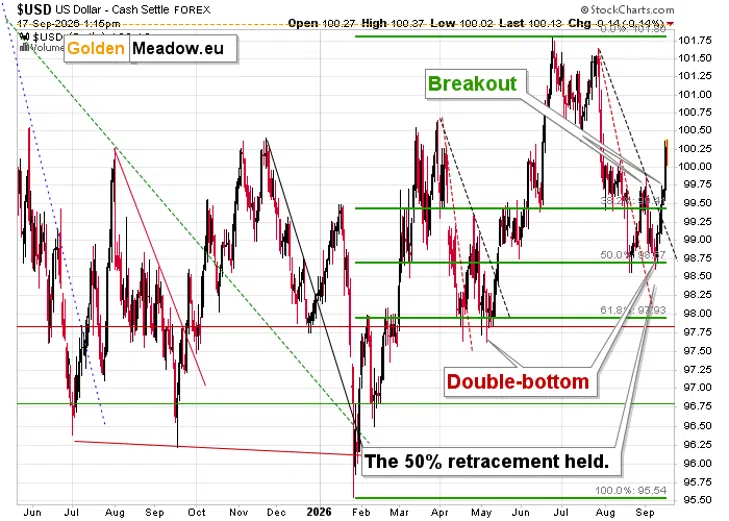
The index rose 0.61 percent on Wednesday to 100.28, its highest close since July 31 and its largest one-day gain since mid-June, on the first hike of the cycle and a two-year yield at 4.72 percent. It is giving back a small part of that this morning, which is what a breakout does the day after it happens. The double bottom that formed at the late-May low is now confirmed by a close above 100, and the pattern I described a week ago has its follow-through.
Please note that after the previous double bottom – in May – the USD Index consolidated after the initial part of the rally. Consequently, a pause or consolidation here wouldn’t change the bullish outlook.
[Today, I’m leaving out the precious metals section to Gold Trading Alerts subscribers.]
Stocks: Lower On The First Hike, First Time Since 1997
The Dow fell 1.21 percent to 51,462, the S&P 500 0.45 percent to 7,551, its lowest close since July, and the Nasdaq was flat, after all three had been higher into the decision. The turn came during the press conference, not at the announcement, which tells you the market was positioned for "one and done" and got "work to do."
On Tuesday, I wrote that the S&P 500 had reached the 1.618 Fibonacci extension of the 2020-2022 rally and that "it makes perfect sense for the top to be in." Wednesday's close is 1.4 percent below the Friday high, and the index has now fallen in seven of the last nine sessions.
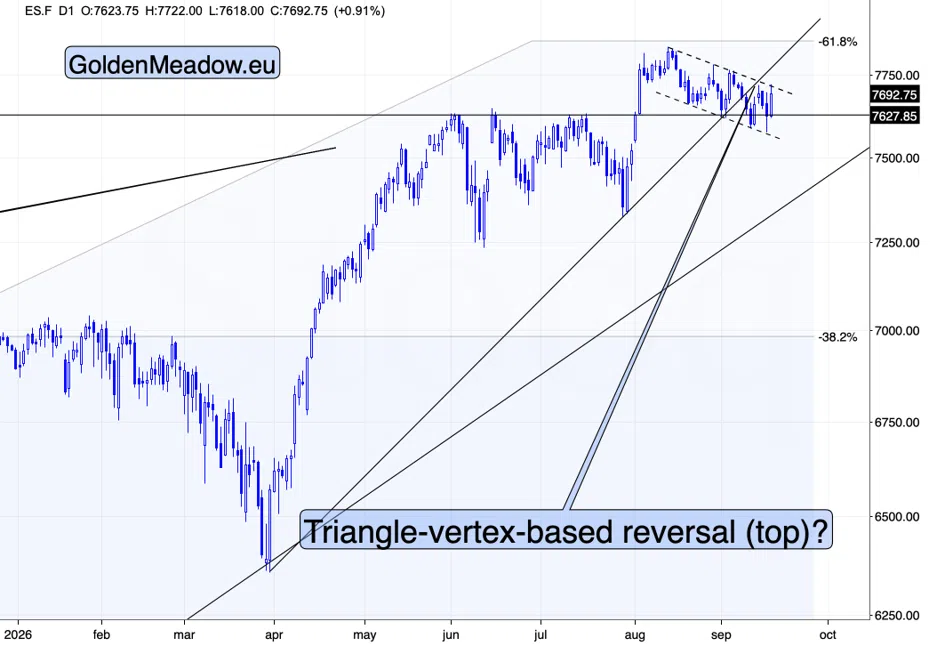
This morning's bounce is real and it is narrow: futures moved up by about 1.3 percent on the S&P and 1.7 percent on the Nasdaq, led by Nvidia and Amazon up 2 percent each and Intel up 3 percent on reports of a memory-chip venture with SK Hynix, with the 10-year yield back below 5 percent at 4.95. That is the AI complex bouncing for the third session since its chief executives called for a slowdown, and the 10-year giving back a few basis points of a 25-basis-point, three-week rise. The day after a hawkish hike, with October half priced, is a session in which relief gets bought. It is not a session in which the trend changes.
Technically, nothing changed since the S&P 500 remains within the declining trend channel. After moving to its upper border, the S&P 500 index declined once more. No breakout means no change in outlook. And higher rates and higher crude oil prices keep pushing companies’ costs, threatening their profitability. And speaking of crude oil…
Oil: Days Or Weeks
Oil is lower for a second day, WTI near $103 and Brent near $105, on two reports. Energy Secretary Wright said the damaged East-West pipeline would restart "in days," while independent analysts and Saudi officials have said weeks. And Saudi Arabia is rerouting: Kpler counted four supertankers with 8 million barrels of capacity loading at Ras Tanura and Juaymah on Tuesday for the Omani route through Hormuz under US escort, and the kingdom is reported to be offering ship-to-ship transfers to cover cancelled September cargoes.
Two vessels have been attacked in the strait since Saturday, Iran has not moved off its condition that Washington meet its terms before the strait reopens, and Brent is still above $105. What has changed is that the market has been given a reason to expect the bypass to return. The last two reasons of that kind, the Salalah meeting and the Friday CPI relief, lasted a session each.
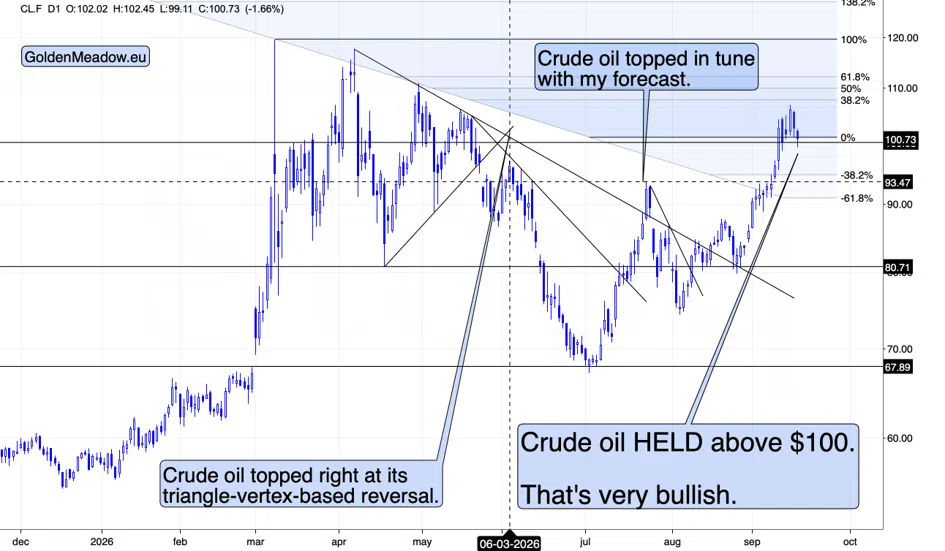
Once again, crude oil held above $100. It rallied back up after touching it. This looks like a verification of the breakout.
President Trump said on Sunday, again, that the war will end "right after the midterms," adding that "we'll ultimately get out, unless we decide to stay and keep the oil, like Venezuela." Last week I laid out the record on the pre-election window. The president has now put the end of the oil shock on the other side of it, in his own words, twice.
The Data
August retail sales rose 1.2 percent against 0.8 percent expected, and the largest contributor was gasoline stations, up 3.1 percent. J.B. Hunt warned that fuel and labor costs will cut third-quarter earnings by 5 to 10 percent from the second quarter and fell 12 percent. Both are the same fact from opposite sides: consumers are spending more because oil costs more, and companies are earning less because oil costs more. The Fed's 16 dots read that fact the same way.
The Calendar
The Bank of England held the rates, the Security Council votes on Iran sanctions today, the BoJ decides on Friday with a hike expected and the yen at a seven-month high, and Friday is quadruple witching, two days after the hike.
Where This Leaves Us
The Fed did what the bond market told it to, the dot plot said more, the two-year confirmed the reading, and the dollar broke out to a seven-week high on the day. Gold absorbed it without rallying, silver is leading again into a morning bounce, and stocks fell on a first-hike day for the first time in almost three decades before a tech-led rebound that has the 10-year still at 4.95 percent.
The question before the meeting was whether the market would wait for the Fed to agree. It agreed, and the dollar was the first to say so.
Thank you for reading the free version of today’s analysis. I encourage you to subscribe for the premium version today. If you’re not ready to subscribe yet, I encourage you to sign up for my free gold newsletter now.
Thank you.
Sincerely,
Przemysław K. Radomski, CFA