


Iran seized two commercial ships in the Strait of Hormuz this morning and fired on a third.
Iranian state media aired a video of IRGC soldiers boarding container ships. Panama condemned the "illegal seizure." Gold fell.
That sequence tells you everything you need to know about this market.
The MSC Francesca (Panamanian-flagged, Italian-owned, 11,312 TEU container ship) and the Epaminondas (Liberian-flagged, Greek-owned, 6,690 TEU) were both captured by IRGC naval forces. Both had turned off their transponders, attempting to transit the Strait without Iranian authorization. A third vessel, the Euphoria, was fired on and is now stranded on Iran's shores. Lloyd's List confirmed at least one boarding. Both seized ships are currently drifting off the Iranian coast.
This is the first time Iran has seized commercial vessels since the war began. For weeks, the IRGC fired warning shots, launched drones, and damaged bridges. Today it crossed a line: capturing ships and holding crews. The IRGC Navy warned that "any disruption to order and safety in the strait" would be considered a "red line."
The White House response was striking. Press Secretary Leavitt said Trump does not view the seizures as a ceasefire violation. "These were two international vessels," she told Fox News. Iran seizes ships in a war zone. The White House shrugs. That tells you how far the goalposts have moved on what constitutes a "ceasefire."
Why No Deal is Coming: The IRGC Takeover
This week confirmed something I flagged previously, when I wrote about the Araghchi-vs-IRGC split explaining why the Strait reopening collapsed in 18 hours. The picture is now much clearer, and much worse for anyone expecting a negotiated resolution.
The Institute for the Study of War (ISW) reported that IRGC Commander Major General Ahmad Vahidi has effectively taken control of Iran's war decision-making, sidelining the civilian negotiators. After the first Islamabad round, Vahidi and his deputies rejected much of what Iran's own negotiators had discussed. When Araghchi announced the Strait reopening on April 18, the IRGC refused to implement it and began publicly attacking him. Vahidi tried to insert his own man (Zolghadr) into the negotiating team over Ghalibaf and Araghchi's objections.
A US official told Axios: "We saw that there is an absolute fracture inside Iran between the negotiators and the military, with neither side having access to the supreme leader, who is not responsive."
This explains much of what happened in the past two weeks. Why the Strait reopening collapsed in 18 hours: Araghchi announced it, the IRGC overruled him. Why Iran refused to send a delegation to Islamabad: Vahidi vetoed it. Why Ghalibaf talks about "new cards on the battlefield" but can't deliver a deal: he doesn't control the cards. The IRGC does.
The assassination of Ali Larijani, who served as the key coordinator between Iran's factions, removed the last structural bridge between the military and the diplomats. His replacement, Zolghadr, is described as "not effective" by US officials. And Supreme Leader Mojtaba Khamenei is "barely communicating," leaving no one with the authority to override the IRGC.
For markets: this means any negotiated deal requires Vahidi's buy-in. Vahidi is a lifelong IRGC commander who pushed the Assembly of Experts to select Mojtaba as Supreme Leader. He is not going to agree to reopen the Strait, abandon the nuclear program, and disarm Hezbollah in exchange for sanctions relief. That's not a negotiating position. That's a description of the regime's extinction.
The frozen conflict isn't frozen because of diplomatic failure. It's frozen because the people with guns don't answer to the people at the table.
Trump: "No Time Frame" (Publicly). "3-5 Days" (Privately).
Trump told Fox News yesterday there is "no time frame" for ending the war and "no time pressure" on the ceasefire. He denied that midterm politics are driving his approach. "People say I want to get it over because of the midterms, not true," he said. In my opinion, it’s exactly the opposite. It seems to me that he was expecting a quick victory. For context: he initially said the war would last four to six weeks. It's now at eight.
Leavitt reinforced this at the White House: Trump is "satisfied" with the economic pressure campaign and has not set a "firm deadline" for Tehran to respond.
But Axios reported something different: Trump is privately giving Iran 3-5 days to unify behind a proposal before the ceasefire extension ends. Three US officials confirmed this. Air Force Two sat on the tarmac at Joint Base Andrews for hours, ready to take Vance to Islamabad, before the trip was cancelled.
So "indefinite" may mean "until this weekend." If Iran doesn't produce a unified proposal by Sunday or Monday, the TACO pattern faces its next test. The question is whether Trump follows through on the threat to resume bombing, or whether he extends again. His track record suggests extension. But each extension makes the eventual escalation, when it comes, more violent.
Meanwhile, CENTCOM said it has now turned back or boarded 31 ships since the blockade began on April 13. Bessent said Iran's Kharg Island oil storage is nearly full. The economic stranglehold is tightening regardless of what happens diplomatically.
The Lebanon Clock: April 27
Israel and Lebanon are meeting in Washington today for a second round of direct talks. Lebanon will request a one-month extension of the 10-day ceasefire, which expires Sunday, April 27.
This matters for the Iran situation directly. Iran linked the Strait of Hormuz to the Lebanon ceasefire on April 17. When Israel and Hezbollah stopped shooting, Iran briefly opened the Strait. When Israel resumed strikes in southern Lebanon, the IRGC closed it again. The two conflicts are connected by Iran's explicit choice.
There are some positive signals. Israeli FM Saar said Israel has "no serious disagreements" with Lebanon. Lebanon's President Aoun confirmed contacts are underway to extend the ceasefire. The first round on April 14 produced enough progress to justify this second meeting.
But the ceasefire is already fraying. Hezbollah fired rockets and drones at Israeli forces on Tuesday for the first time since the truce began, saying it was responding to Israeli destruction of homes in southern Lebanon. Israel maintains a 10km buffer zone in the south and has sentenced two soldiers for smashing a statue of Jesus Christ in a Lebanese church. A Lebanese journalist, Amal Khalil of the Al-Akhbar newspaper, was killed today in an Israeli airstrike in southern Lebanon.
If Lebanon gets its 1-month extension, one escalation trigger is removed. If the talks fail and the ceasefire collapses Sunday, Iran has the stated justification to escalate further in the Strait. Given today's ship seizures, the IRGC doesn't need much justification. But the Lebanon collapse would give it legitimacy.
The Silence is Golden
Yesterday, I titled the analysis "Worse for Gold Than Active War." Today's price action is making that thesis look conservative.
Iran seized two ships. Fired on a third. State media broadcast soldiers boarding container ships. Panama issued a formal condemnation. Trump said there's "no time frame" for ending the war. The Pentagon said mine clearance will take six months after the war ends. The Senate rejected war powers restrictions for the fifth time.
The situation looks bad, and it looks very tense. And yet…
Gold is down.
The pattern is confirmed. Gold is not responding to geopolitical risk. It is responding to the channel: oil elevated → inflation sticky → Fed frozen → dollar supported → gold pressured.
The frozen conflict maintains everything that's bearish for gold (oil disruption, inflation, dollar strength) while removing the one thing that was bullish (acute fear that generates safe-haven spikes). Ships being seized in the Strait doesn't change that calculus. It's chronic, not acute. The market has priced in continuous low-level hostility. What it hasn't priced in is the structural oil disruption that feeds through to inflation, rates, and the dollar.
Silver's 2.52% decline today after yesterday's rally confirms the dead cat bounce. The white metal gave back its entire gain and then some.
Technically Speaking
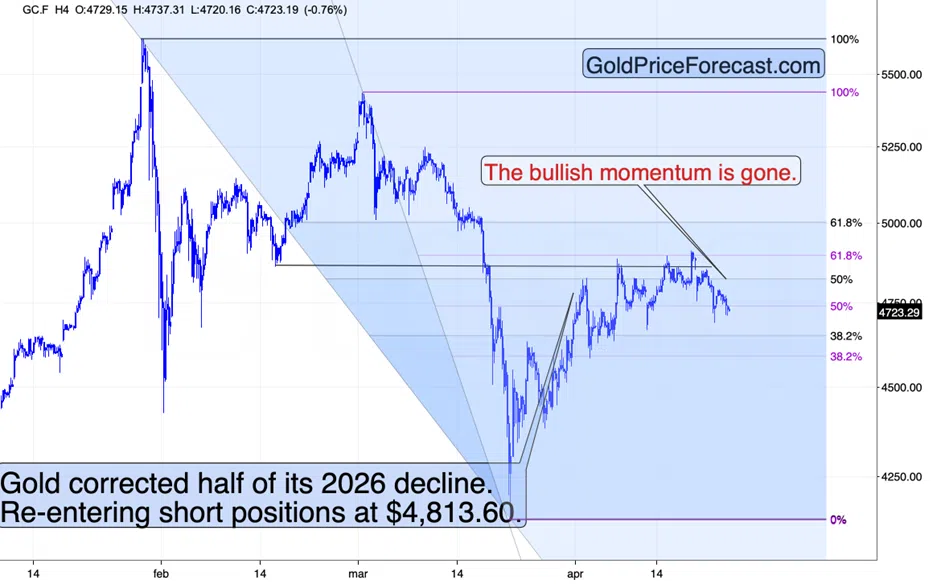
Gold is now well below $4,800 and almost below $4,700. Yesterday's bounce lasted one session. The corrective upswing that started in early April appears to be over based on the failure at the 50% Fibonacci retracement and the subsequent decline to new weekly lows.
The bullish momentum is gone.
[EDIT: I’m adding this after gold’s rebound that erased the overnight decline – this changes nothing – the bullish momentum is gone either way.]
Thank you for reading today's article – the free version of today's Gold Trading Alert (in which the analysis continues). Subscribers receive the full analysis with charts, technical levels, and trading positions daily. Gold Trading Alerts are available directly and through the Diamond Package.
Thank you.
Sincerely,
Przemyslaw K. Radomski, CFA