


Twenty-one hours of talks. No deal. Vance boarded Air Force Two.
The entire US negotiating team left Islamabad. Nobody stayed behind for back-channel discussions.
Then Trump announced a naval blockade of the Strait of Hormuz.
Oil surged 8% to $104. Gold fell. Again. And Silver fell even more.
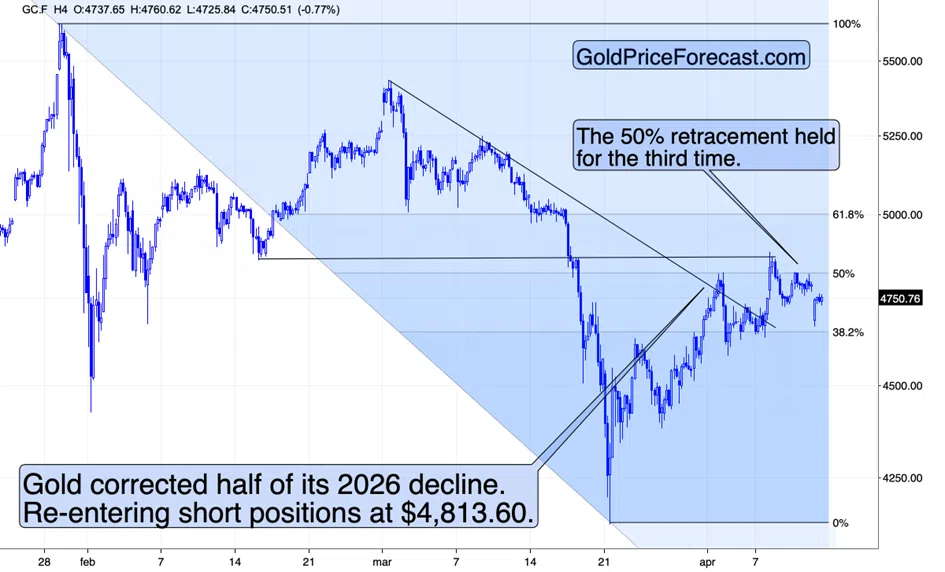
Let me walk through what happened, what it means, and why today's price action is the clearest confirmation yet of the thesis I've been featuring for the past few weeks.
The Islamabad Talks: What Broke Down
The talks at the Serena Hotel ran from Saturday afternoon through Sunday morning. Three-way format: US (Vance, Witkoff, Kushner), Iran (Parliament Speaker Ghalibaf, Foreign Minister Araghchi), with Pakistan (PM Sharif, Army Chief Munir) mediating. It was the highest-level direct US-Iran engagement since 1979.
According to a US official, Iran refused to concede on four red lines: ending all uranium enrichment, dismantling major enrichment facilities, allowing retrieval of highly enriched uranium, and fully opening the Strait without tolls. Iran also refused to stop funding Hamas, Hezbollah, and the Houthis.
Iran tells a different story. Foreign Minister Araghchi said they were "inches away from an Islamabad MoU" but then encountered "maximalism, shifting goalposts, and blockade." Ghalibaf said the US "failed to gain the trust of the Iranian delegation" and pointed to "the experiences of the two previous wars."
A US official offered a revealing detail: Vance came away from the 21 hours with the conclusion that Iran had "misperceived their negotiating strength," that "the Iranians believe they have leverage that the U.S. believes they lack." This is an important psychological tell. The US side thinks Iran is bluffing. Iran thinks the US is desperate. Both think time is on their side. Both can't be right.
Based on my analysis of Trump's psychological profile, Trump processes each interaction as a discrete episode to be won. Vance leaving with a "final and best offer" is classic Art of the Deal: walk away, project indifference, force the other side to come to you. "To speed up negotiations, be indifferent," Trump wrote in 2008. But Iran has read this playbook too. Ghalibaf's line about "experiences of the two previous wars" is a direct reference to the JCPOA, which Trump himself tore up. Iran's trust deficit with the US is structural, not tactical.
Trump: "Whether we make a deal or not makes no difference to me. We've won." This is an exit-narrative construction. The episodic man is already framing this as a victory regardless of the outcome, which means he's preparing to move on.
The Blockade: Escalation or Theater?
Hours after the talks collapsed, Trump announced: "Effective immediately, the United States Navy will begin the process of BLOCKADING any and all Ships trying to enter, or leave, the Strait of Hormuz."
CENTCOM followed with specifics: the blockade begins today, April 13, at 10 AM ET. It targets "all maritime traffic entering and exiting Iranian ports," but will not impede vessels transiting the Strait to and from non-Iranian ports.
This distinction matters. Trump's Truth Social post said "any and all ships." CENTCOM's operational order is narrower: Iranian port traffic only. The gap between rhetoric and operations is now standard. Two US destroyers (USS Frank E. Peterson and USS Michael Murphy) transited the Strait Saturday and began mine-clearing operations while the talks were still going on. Diplomacy and military escalation are happening simultaneously.
Iran's response: the IRGC warned that military vessels approaching the Strait "will be dealt with harshly and decisively" and considers any such approach a ceasefire violation. Iran denied that the US warships even passed through. The ceasefire, already on life support, now faces a direct military test.
There is also an intelligence report that China is planning to provide air defense weaponry to Iran in the coming weeks. Trump warned China of "big problems." The Chinese Embassy denied it. If true, this adds a new variable to the conflict that I'll track closely.
Meanwhile, the UK confirmed it will not join the blockade. PM Starmer said plainly: "We are not supporting the blockade" and the UK "is not getting dragged in." Australia's PM Albanese said the same: "We've received no requests. They've made this announcement overnight, and they've done that in a unilateral way." France and the UK are instead organizing a parallel coalition, separate from the US blockade. Macron announced that France and the UK will convene a conference "in the coming days" for countries willing to contribute to a "strictly defensive, peaceful multinational mission aimed at restoring freedom of navigation." So Trump said "other countries will be involved," but the three closest allies are all distancing from his approach while building their own. The US may be operationally alone in the blockade.
Iran's response went further than threatening the Strait itself. The IRGC said today: "No port in the Persian Gulf and the Sea of Oman will be safe" if Iranian ports are threatened. "Security of ports in the Persian Gulf and the Sea of Oman is either for everyone or for no one." Iran's armed forces called the blockade "an illegal act" that "amounts to piracy." This is a significant escalation. The threat is no longer limited to the Strait. It now encompasses every port in the Gulf, including Saudi, Emirati, Kuwaiti, and Qatari facilities. If Iran retaliates against the blockade by disrupting ALL Gulf port operations, the supply situation gets dramatically worse than anything we've seen so far.
The Wall Street Journal reported that Trump is considering resuming limited military strikes on Iran, which would formally end the ceasefire.
What Iran Actually Has
I've written extensively this week about Iran's position, from the toll booth analysis to the ceasefire collapse to the sea mines confirmation. Here's where things stand:
Iran controls both shores of the Strait. The waterway is mined (officially confirmed Thursday via the IRGC's published map). The alternative routes the IRGC designated run closer to Iranian military positions. Only about 6-12 ships per day pass through (vs 100-120 pre-war). 230 loaded oil tankers are waiting inside the Gulf, according to ADNOC's CEO. Iran has bilateral passage agreements with China, India, Russia, Iraq, and Pakistan, giving it the ability to selectively reward allies while punishing others.
There is also a detail that sounds almost absurd but carries serious implications: according to one report, Iran has lost track of some of the mines it planted in the Strait. If accurate, this means even if Iran wanted to fully reopen the waterway as part of a deal, it physically cannot guarantee safe passage. The mine-clearing timeline isn't just a diplomatic question. It's a physical one that neither side can shortcut.
The US blockade of Iranian ports is a response, but it doesn't solve the problem. Iran's oil exports were already near zero due to pre-war sanctions. The blockade's practical impact is limited. What Iran cares about is Strait control, and a US blockade of Iranian ports doesn't change the mine field, doesn't change the IRGC's position on both shores, and doesn't change the physical reality that reopening the Strait takes months.
The blockade does something else, though. It makes the Strait situation worse for everyone who isn't Iran. Ships transiting to non-Iranian ports (Saudi, Emirati, Kuwaiti, Qatari) now face not only Iranian mines and IRGC supervision but also the risk of being caught between US Navy operations and IRGC threats. The insurance premiums that were already prohibitive will rise further. The handful of ships that were getting through may stop.
This is why oil surged 8% today. The market correctly read the blockade as making the Strait less passable, not more. More precisely: markets are starting to read the situation – I think they haven’t priced in the escalation yet.
The Blockade's Strategic Logic and Its Contradictions
To be fair to the U.S. administration, the blockade has a clear strategic rationale: cut off Iran's remaining oil revenue, deny Tehran the economic benefit of Strait control, and force concessions by tightening the financial noose. The US used a similar approach against Venezuela earlier this year (intercepting sanctioned crude on the open seas before the January capture of Maduro), and that worked.
The problem is that Iran is not Venezuela. Venezuela didn't control a chokepoint through which 20% of the world's oil flows. The asymmetry runs in the wrong direction here. Iran's oil exports were already near zero due to sanctions, so blocking Iranian ports has limited incremental impact on Tehran. But the operational presence of US warships in a mined waterway alongside IRGC forces, who have explicitly warned they'd respond with force creates a daily risk of miscalculation. Bloomberg ran an opinion piece titled "Strait of Hormuz Blockade Is a Throwdown the US Cannot Win," noting that energy blockades are inherently slow-burn tools while the administration's political clock demands a quick result.
CNN raised a separate point: the US had actually been allowing some Iranian oil through because any oil leaving the Gulf helps keep global prices in check. The blockade cuts that off too, tightening supply further at a moment when American consumers are paying $4.13 per gallon.
Iran's Parliament Speaker Ghalibaf responded by posting a map of gas prices near the White House and writing: "Enjoy the current price of gasoline. With what is being called a 'blockade,' you will soon miss $4 to $5 gasoline." Whether one likes the messenger or not, the underlying math is hard to dispute.
Iran's "Untapped Leverage"
The most important signal from today came from Mohsen Rezaee, military adviser to the Supreme Leader, who said Iran "will not allow" the blockade and has "great untapped leverage to counter it."
What does "untapped leverage" mean? Bloomberg's analysts provided one answer: "Beijing may even use its leverage over the US with critical minerals in an effort to pressure Trump." Combined with the intelligence report about China planning to provide air defense weaponry to Iran, the implication is that Iran is signaling it has a superpower patron willing to counterbalance US pressure. China gets a third of its oil via the Strait. China has every reason to oppose a US blockade that cuts off its supply.
There are other possibilities. The IRGC's threat today that "no port in the Persian Gulf and the Sea of Oman will be safe" is itself a form of untapped leverage being previewed. A top adviser to Khamenei recently suggested the Houthis could close the Bab al-Mandeb strait as well. Two chokepoints closed simultaneously would be unprecedented. Iran could also escalate proxy attacks on US bases in Iraq or against Gulf state infrastructure (they hit a tanker in Kuwait early in the war, 800km from the Strait itself).
The deliberate vagueness of "untapped leverage" is probably the point. The ambiguity is itself a form of leverage. It forces every analyst, every insurer, and every ship captain to imagine the worst case.
I'm not taking sides on whether the blockade is right or wrong. That's a political judgment. What I'm tracking is the market impact, and the market's verdict today was unambiguous: oil +8%, which means the blockade made the supply picture worse, not better, at least in the short term. Whether it produces results over weeks or months is a separate question, and I'll continue tracking it.
Gold Falls on the Worst Possible News. The Channel Wins.
Here are today's prices:
Oil (WTI): $104.20, up 7.90% Brent: up 7.58% European natural gas futures: up 18% Heating oil (jet fuel proxy): up 10% Gold: down 0.66% Silver: down 2.28% Dollar (DXY): up 0.31% S&P 500: down 0.53% Nasdaq: down 0.83% Bitcoin: down 0.95%
This is the oil/inflation/USD channel operating at full power. I described this channel earlier in the week: oil up → inflation stickier → Fed frozen → dollar supported → gold pressured.
Today is the purest test case yet. The talks collapsed. The US announced a blockade. The IRGC threatened to attack warships. Oil surged to $104. China may be arming Iran. The ceasefire is crumbling. And gold fell.
If gold were going to rally on geopolitical fear, today was the day. It didn't. Instead, it confirmed, for the fourth consecutive session, that the structural channel dominates.
Monday (Apr 7): gold flat on Trump's "whole civilization will die" deadline. Tuesday: brief rally on ceasefire euphoria, then shooting star reversal. Wednesday through Friday: gold drifts lower while the situation deteriorates. Today (Monday, Apr 13): talks collapse, blockade announced, oil surges 8%, gold falls 0.66%.
Four data points in the recent past. All pointing in the same direction. The safe-haven narrative for gold is broken in this environment. Oil is the driver, and oil is driving in the wrong direction for gold.
Silver's 2.28% decline is even more telling. Silver has more industrial sensitivity than gold, and it's being dragged down by both the dollar strength and the growth concerns that $104 oil creates. The combination is particularly toxic for silver in the short- and medium term.
Oil: Why $104 May Be the Beginning, Not the Destination
I previously suggested oil might stabilize in the $90-110 range. It seems to me that I was too conservative given the presented thesis. If the Strait stays at 5-15% capacity for months (which is exactly what the failed talks, the mine map, and the IRGC's "never return to previous status" declaration all point toward), the supply math doesn't support stabilization. It supports continuation higher.
The IEA released 400 million barrels from strategic reserves. Spread over two months, that covers about 6.6 million bpd of the roughly 17-19 million bpd shortfall. Asian reserves are depleting. Taiwan has 11 days of supply. Japan about 3 weeks. When those run out, Asian buyers become desperate bidders for whatever non-Gulf oil is available.
The US blockade makes this worse. By targeting ships that paid tolls to Iran, it puts the US in conflict with China and India, the two countries that were getting some oil through. If that trickle stops, the shortfall widens.
Gas prices hit $4.13 per gallon, up $1.14 since the war began. Heating oil jumped 10% today. Jet fuel proxies surged. The inflationary impulse from oil is not theoretical. It's hitting consumers now. US consumer confidence plunged to a record low in April, according to the University of Michigan survey. Germany announced emergency fuel tax cuts (17 euro cents per liter for two months) as Chancellor Merz said the war "is the root cause of the problems we face in our own country." Columbia University's Karen Young, a senior scholar at the Center on Global Energy Policy, said elevated oil prices are "certain" through the end of 2026 and warned "it could be a long time from now" before prices decline even after the war ends.
The implications for the Fed are clear: rate cuts are off the table as long as oil is above $100 and rising. The market was pricing in three cuts for 2026 before the war. Now it's priced at zero. That's the channel that keeps gold pressured.
Thank you for reading today’s free analysis. Its full version includes the 4-week geopolitical forecast, technical coverage of gold, silver, mining stocks, crude oil, stocks, dollar, and copper, and specific target prices for our trading positions. I encourage you to subscribe to Gold Trading Alerts or the Diamond Package and read it today.
Thank you.
Sincerely,
Przemyslaw K. Radomski, CFA