


So much for gold’s safe-haven status?
The US-Israel war against Iran entered its 10th day over the weekend, and the escalation took a form that markets had been dreading. Late Saturday, Israeli air forces struck 30 fuel depots in and around Tehran for the first time since the war began. Massive fires blanketed Iran's capital in toxic black smoke. Four oil distribution employees were killed. Fuel distribution in the city was temporarily halted.
This was not a measured response. According to Axios, the American message to Israel was blunt, and the strikes went far beyond what Washington expected. US Energy Secretary Chris Wright clarified that the US has "no plans" to target Iran's oil industry, and that the fuel depot attacks were Israel's decision alone. So we now have the first significant US-Israel disagreement of the conflict, and it involves the one thing that affects every single market on the planet: oil supply.
The Strait of Hormuz, through which roughly 20% of global oil passes, has been effectively closed since early March. Iraq's oil output dropped 70% (from 4.3 million barrels per day to 1.3 million) because there's nowhere to put the crude. Kuwait declared force majeure. Bahrain's state oil company Bapco did the same after an Iranian drone attack on its refinery. Qatar had already shut down gas exports on March 4, potentially removing 20% of global LNG supply. Saudi Arabia began production cuts as well.
Then, on Sunday, Iran's Assembly of Experts elected Mojtaba Khamenei, the 56-year-old son of the assassinated Ayatollah Ali Khamenei, as the new Supreme Leader. He's a hardliner with deep ties to the IRGC. The Revolutionary Guard pledged total loyalty to him. President Trump had previously warned that Khamenei's son was an "unacceptable" choice. Iran's response: they elected him anyway. This signals continuation, not compromise.
In short, the weekend brought: strikes on oil infrastructure, a new hardline leader, an ongoing Strait of Hormuz closure, and cascading force majeures across the Gulf.
As a result, crude oil soared above $100, almost touching the $120 level ($119.43 was the overnight high). Stocks plunged in the overnight trading, and – this is the really important part – gold declined while USD rallied.
Yes, gold declined on the escalation of a major military conflict.
If you’ve been following my analyses for some time, this is not surprising to you. You know that the USD has been suppressed for months, and you know that declining stock market values were like to contribute to lower prices of gold, silver, and mining stocks (in particular to lower prices of silver and miners).
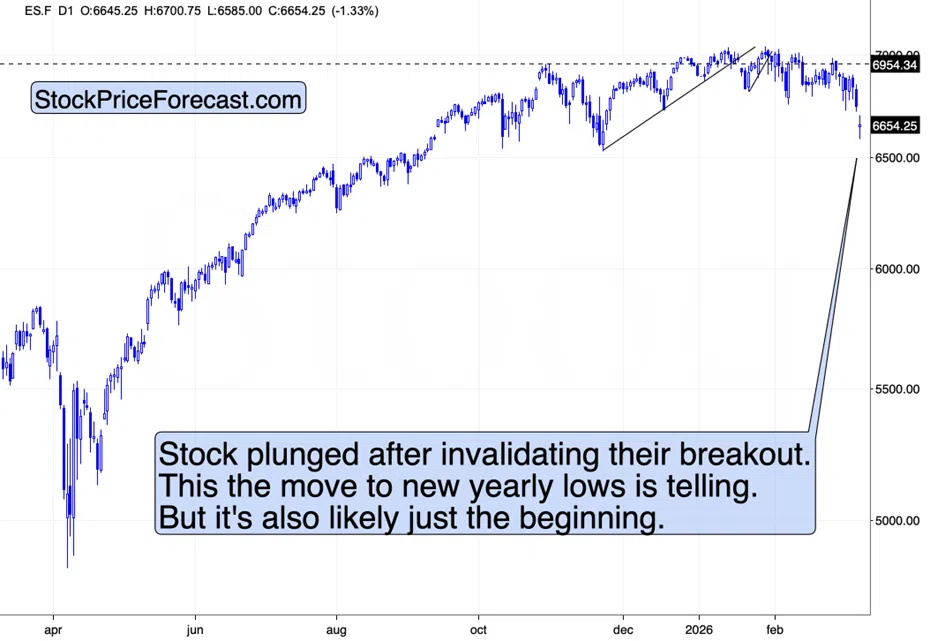
Stocks moved lower, and the move was not minor. Truth be told, it’s not a huge slide either. But this is likely to change.
The fact that stocks (and this is true not just for the S&P 500, but also for the Dow and the NASDAQ moved to new yearly lows today.
Sure, we might see temporary turnarounds – markets fluctuate, and that’s normal. But the sharp rise in the price of oil suggests that this is not a temporary move lower, but rather the beginning of a much bigger collapse.
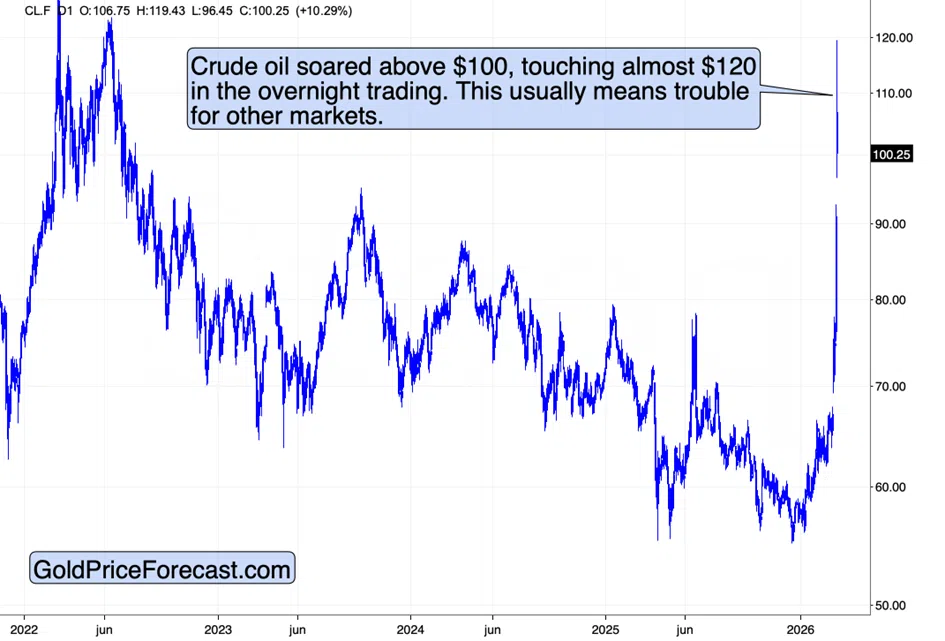
To better understand why this is the case, I created a few charts that show you what gold, silver, stock, and the USD Index did when crude oil previously soared above $100 and moved toward $120.
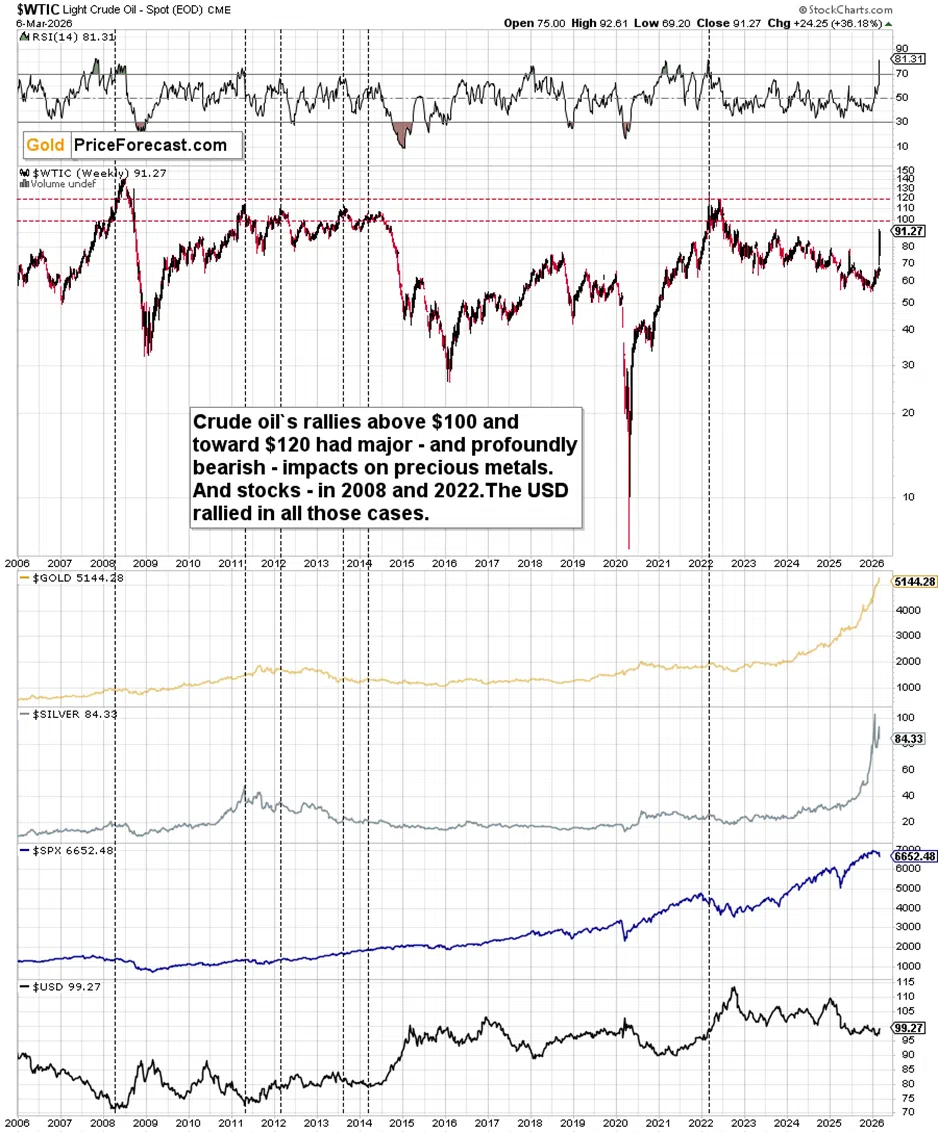
In the previous 20 years, there were only several cases when crude oil did something similar to what happened today, and I marked them on the above chart with vertical, dashed lines.
Two out of those past six cases are particularly similar to today because of the sharpness of the rally – I mean, the 2008 and 2022 cases. The 2011-2014 cases followed a slower rally and were essentially series of oil’s attempts to rally above $100 from the $80-$90 range.
What we can see clearly on the above chart is that the USD Index rallied or soared in the aftermath of each case. It happened either right away, or relatively soon – but it happened each and every time.
Let’s put gold and silver in focus.
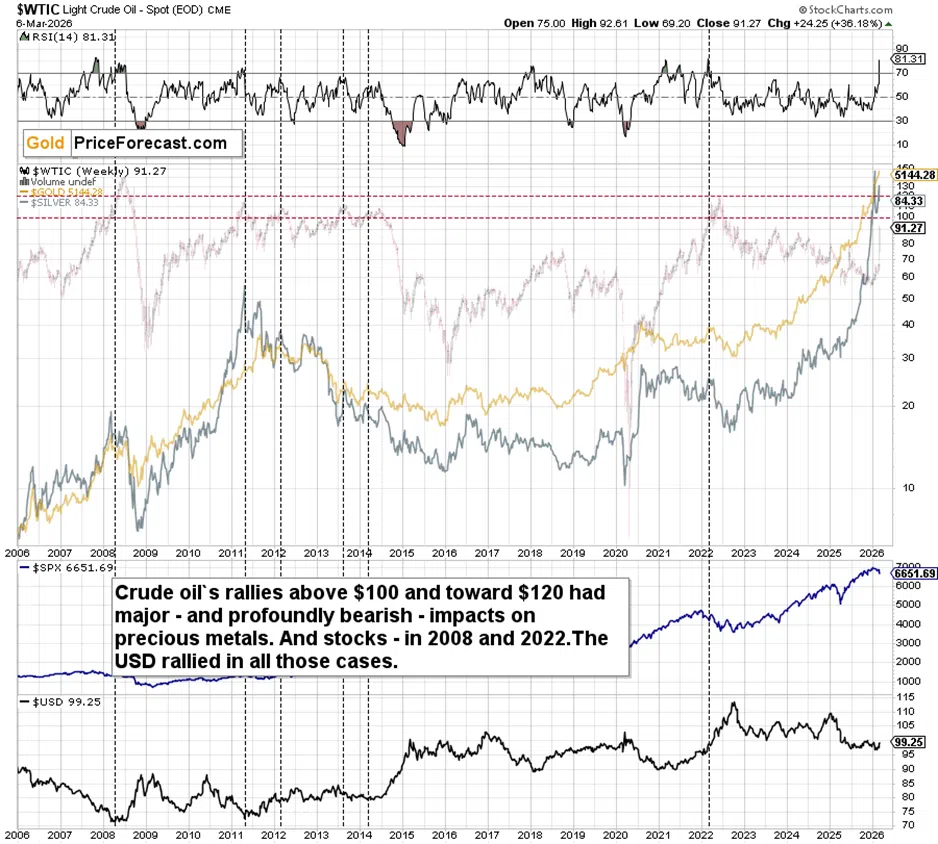
This angle is particularly interesting because it reveals that each of the moves in crude oil, like the current one, preceded major slides in silver, and almost all of them (except for the 2011 one) were followed by declines in gold as well.
In gold’s case, it’s quite clear that we’re after the parabolic upswing that simply continued back in 2011, so I don’t think this exception should be viewed as an important point against the analogy. In other words – just as the USD Index is likely to rally here, gold and silver are likely to fall.
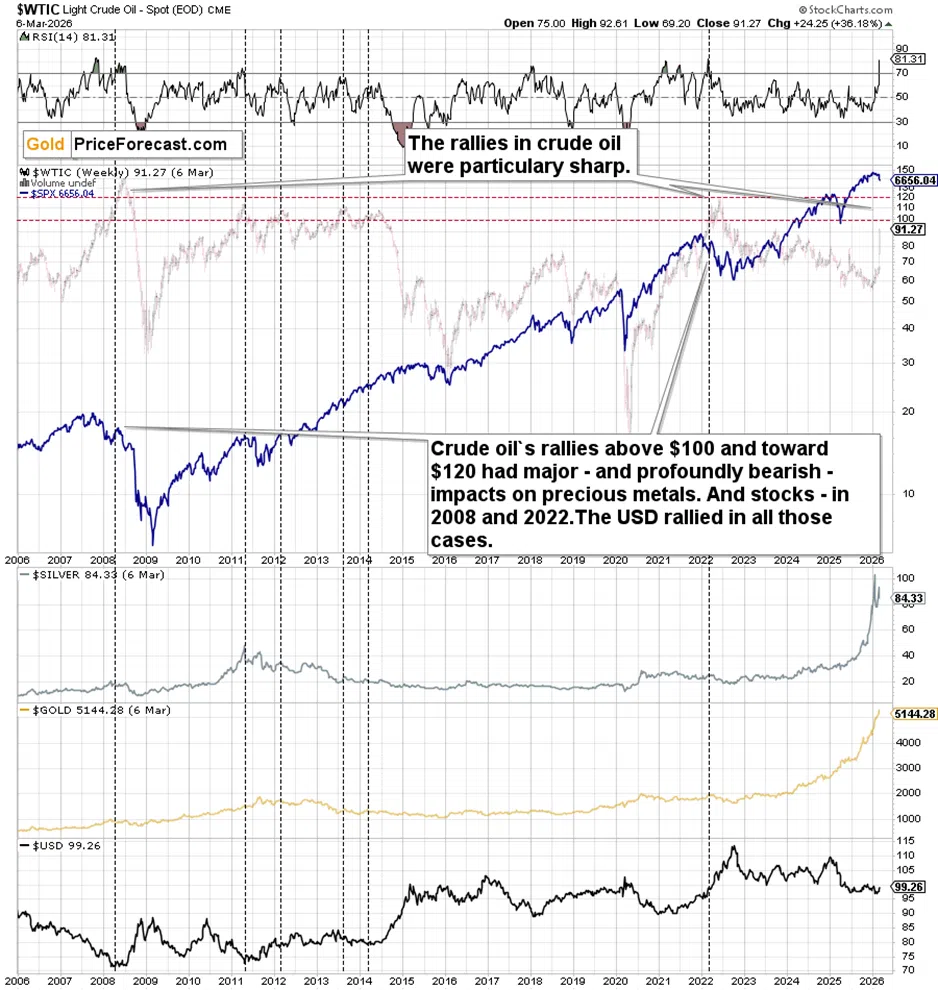
Putting stocks in the spotlight reveals that big declines followed in the two most similar cases (2022 and 2008). In the remaining four cases, the implications were 50/50: we saw short-term declines in 2011 and 2012 and nothing specific (rally continued) in 2013 and 2014.
This is also bearish for the stock market.
The combination of rising USD and falling stock market is likely to be particularly damaging to silver and mining stocks.
Now, silver has fantastic fundamentals, it’s in the sixth year of deficit, and the inventories are shrinking, and you’ll find my more specific take on silver’s current fundamental situation in this article on SilverPriceForecast.com. This means that the decline in its price could be short-lived – but I still think that it will happen.
Thank you for reading today’s free analysis that’s based on today’s Gold Trading Alert, which includes also key trading details. I’ll continue to send you occasional updates and, as always, I’ll keep my Gold Trading Alert subscribers informed at all times.
Thank you.
Przemyslaw K. Radomski, CFA
Founder
Golden Meadow®