


Silver finally soared on its delivery notice day, but… overall the move was not particularly spectacular – compared to what we saw in the previous months.
In fact, it looked… normal.
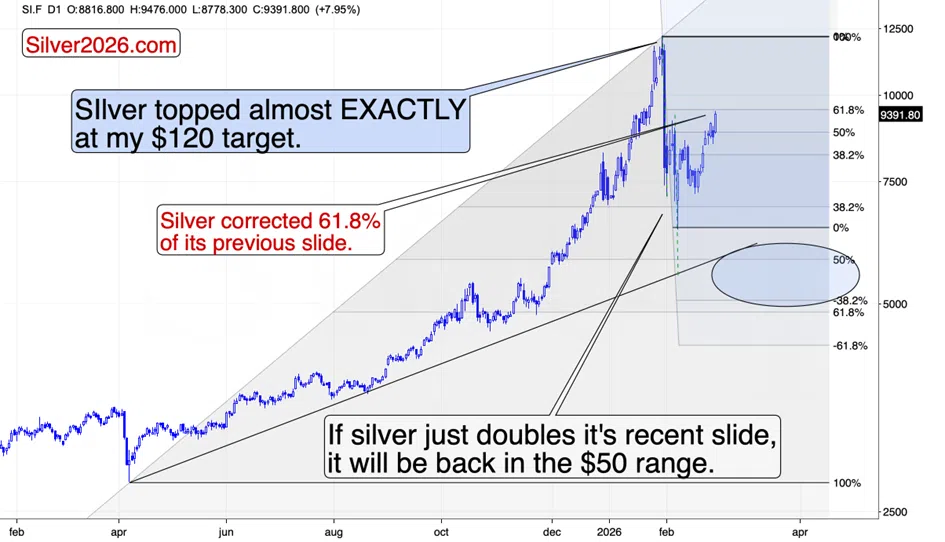
Silver outperformed gold on a very short-term basis – it’s up by 8% today.
Before moving further, let’s take a step back from the chart analysis and discuss the context of recent moves in silver.
COMEX Silver: The Default That Wasn't (Not Yet, Anyway)
On Wednesday, CME Group halted all metals and natural gas futures and options trading on its Globex platform, citing "technical issues." Natural gas resumed within 35 minutes. Metals stayed dark for about 90 minutes. All day orders and good-till-date orders were cancelled. The timing was, to put it mildly, interesting. Today (Feb. 27) is First Notice Day for the March silver contract, one of the year's major delivery months. The halt happened precisely 48 hours before the moment when contract holders formally declare their intent to take physical delivery. If this sounds familiar, it should. On November 27-28, 2025, CME suffered a 10-hour outage due to a "cooling failure" at its data center, which happened to coincide with First Notice Day for the December silver contract. CyrusOne later confirmed that one was caused by human error. Silver spiked to a record $56.78 upon reopening and then doubled to $121 over the next two months.
The silver community has been in full "this is it" mode for weeks. And the numbers behind the excitement are, I have to admit, genuinely notable. And they are in tune with what I wrote in my silver book.
COMEX registered silver (the category deliverable against contracts) sits at roughly 86 million ounces. As of today, 10,526 contracts (52.63 million ounces) are standing for March delivery. These are not small numbers.
And yet. Silver is trading around $94 today. Up about 8% on First Notice Day. No default. No Force Majeure declaration. No emergency cash settlement. I've watched versions of this story play out in 2011, in 2021 during the WallStreetBets silver squeeze, and at several points during the 2024-2025 rally. Each time, the registered inventory numbers look alarming, and highly committed commentators declare that the paper market is about to break. Each time, it doesn't.
Will it happen eventually? I think so. But I think we have some time (in terms of months, maybe years) before that takes place.
This is not because the physical tightness is imaginary. It's real. The drawdown in COMEX registered inventory from 240 million ounces (April 2020) to 86 million ounces today is a 64% decline, and that's a structural shift. But the exchange has a deep toolkit for managing delivery stress without ever formally defaulting. Exchange for Physical (EFP) transactions allow bullion banks to call long holders and offer cash premiums to swap COMEX contracts for London spot positions, settling the contract without a single ounce leaving New York vaults. Margin hikes (which CME deployed again recently) pressure leveraged longs into closing positions before delivery. SLV share redemptions allow metal to be reclassified from "eligible" to "registered" inventory. And if all else fails, CME's Rule 701 permits emergency cash settlement. The fine print of COMEX contracts gives the exchange broad discretion to settle in dollars rather than metal. Many participants in the "default" narrative either don't know this or prefer not to mention it.
Eventually the physical market is likely to overwhelm everything else – but I simply don’t think this is happening yet.
Here's what I'd flag for those watching this space closely. The pattern of CME "technical issues" coinciding with delivery-sensitive dates is, at minimum, raising questions about exchange credibility. Nicky Shiels, head of metals strategy at MKS PAMP SA, told Bloomberg that the latest glitch "erases confidence over liquidity and price discovery." That's a measured statement from a mainstream institutional voice, not a fringe commentator. If these disruptions continue, they will gradually erode trust in COMEX as the benchmark pricing mechanism for silver, which could accelerate the migration of price discovery toward Shanghai and physical markets. That would be a meaningful structural development, but it's not something that’s likely to happen overnight.
For now, the "Not Yet" in the title is doing double duty. COMEX hasn't defaulted yet, and based on its contractual toolkit, it almost certainly won't in the way the loudest voices are predicting – at least not soon. But the physical market hasn't fully resolved its supply-demand imbalance yet either. And this is unlikely to happen anytime soon as well. Silver is poised to soar in the long run. I just think that a rally in the USD Index and a decline in stocks will temporarily overwhelm the silver market and it will slide along with many other markets.
Both of these "not yet" realities will continue to coexist, creating volatility and confusion. The key, as always, is to separate the signal (genuine structural tightness in physical silver) from the noise (the recurring prediction that the paper market is about to break this week). The signal is worth watching. The noise is worth tuning out.
Now, what IS worth monitoring – if one is interested in forecasting gold and silver prices in the following weeks and months is the universally-hated USD Index (and stock market).
Let’s take a closer look.
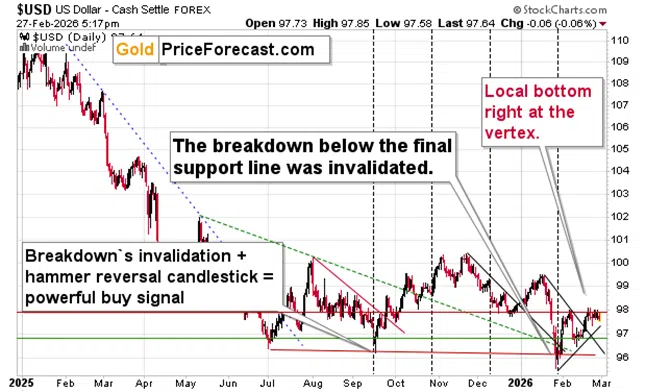
We don’t see much from this point of view beyond the fact that the bottoming process has been in place for over 8 months now.
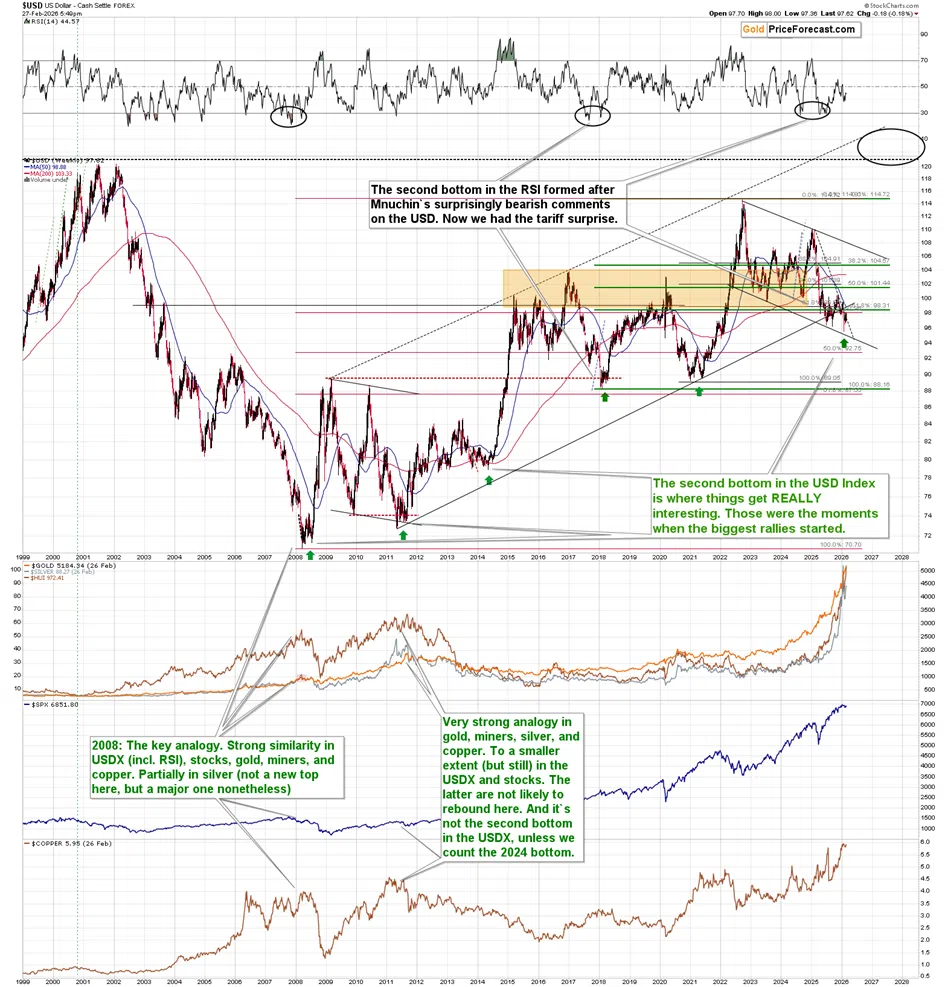
Zooming out shows that those broad bottoms give birth to the biggest medium-term rallies.
And zooming in shows that the support line was just reached, suggesting that the downside here is likely very limited.
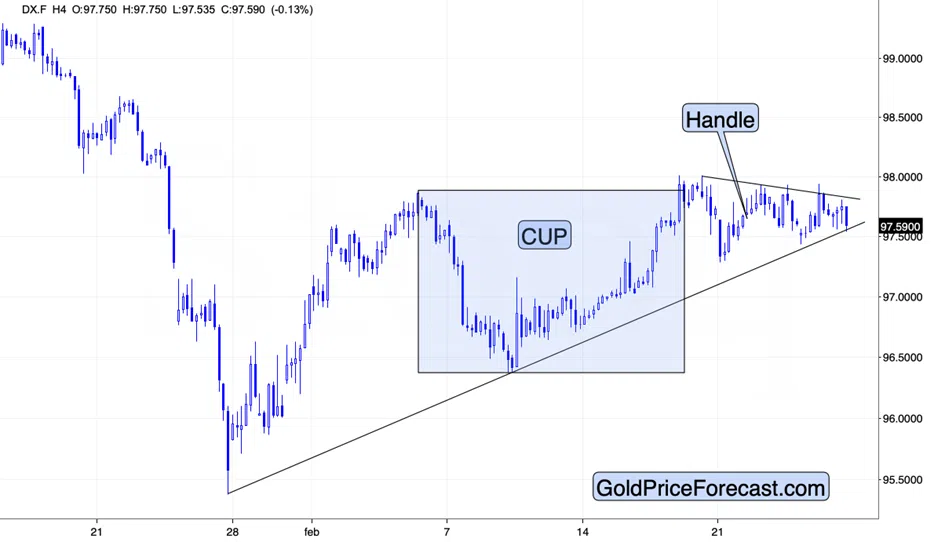
My yesterday’s comments on the above chart remain up-to-date:
Zooming in reveals that the tension is rising. The rising support line is near, and the USD Index just touched it. The declining resistance line is also just ahead.
All this created a bullish cup-and-handle pattern, which now points to a breakout – most likely in the near future as the space between support and resistance narrows.
This breakout would be likely to lead to commodity and precious metals values as well as lower stock values. The latter would be likely to affect mining stocks, silver, and bitcoin more than gold.
The stock market moved lower, but not yet significantly so.
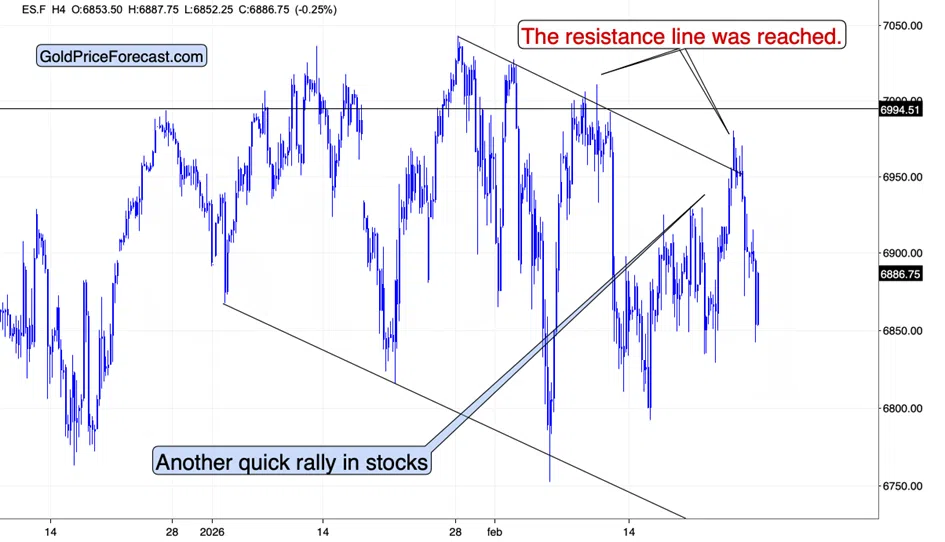
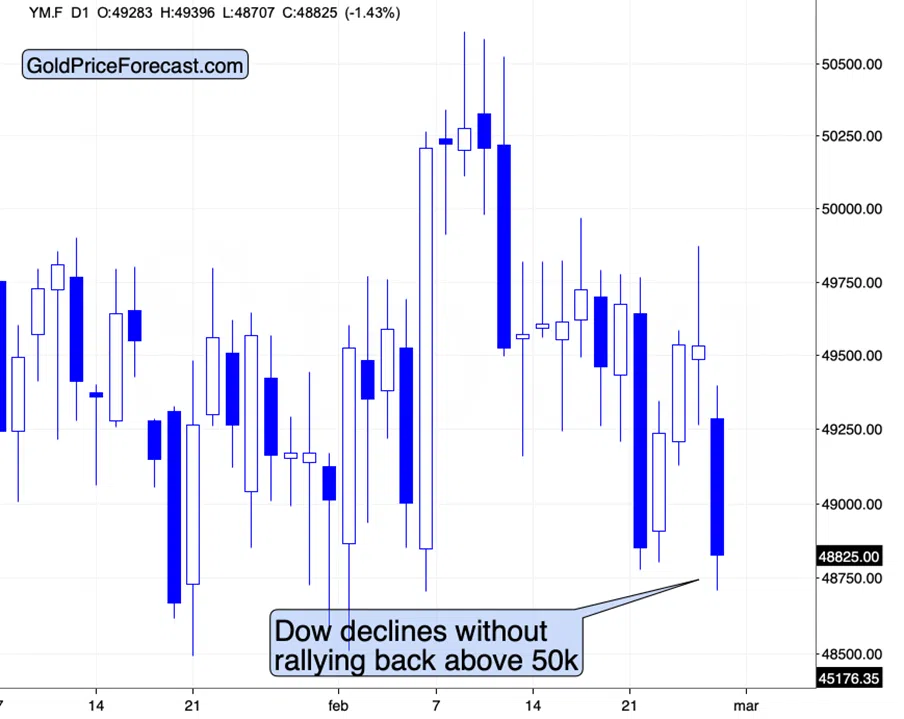
The outlook remains bearish – nothing changed here, and the resistance held.
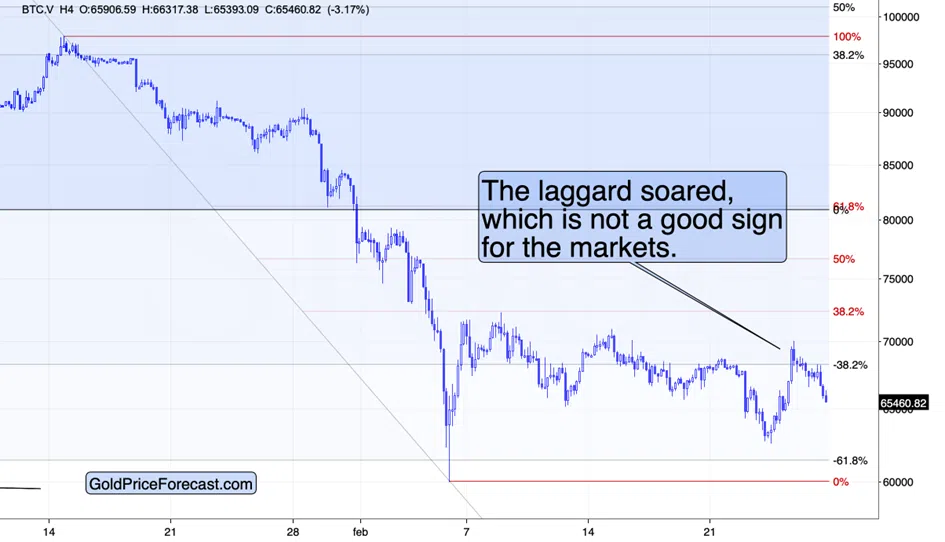
The situation in bitcoin also confirms my previous points. The cryptocurrency is declining, and the rallies that we see in it are “dead cat bounces”.
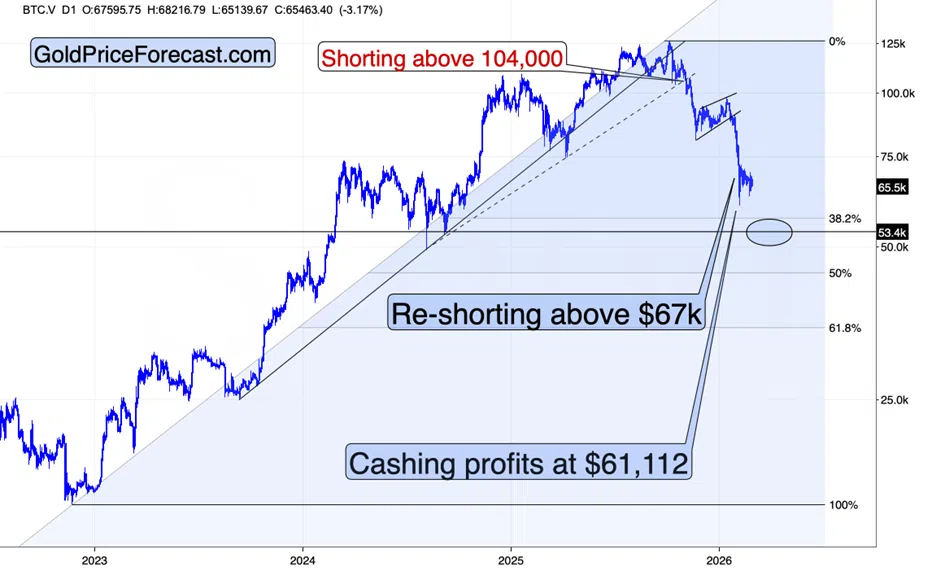
Our profits from the short positions in bitcoin are likely to increase in the following weeks.
This is the clear first crack in the crypto-AI-stock-market system. They all rallied together, and they are all likely to fall together when the USD Index rallies. And, as it turns out, bitcoin didn’t even want to wait for this to happen - it started to slide even beforehand.
Thank you for reading my today’s free analysis. I’ll continue to send you occasional updates and, as always, I’ll keep my Gold Trading Alert subscribers informed (also on insurance-, investment-, and trading-capital-based details) at all times.
Thank you.
Przemyslaw K. Radomski, CFA
Founder
Golden Meadow®