


As crude bounces back and the dollar hits new highs, gold's brief rally is rapidly unravelling.
Gold rallied $59.30 on Friday to settle at $4,216.30. It opened higher in Asia today, when oil dropped on President Trump's announcement of an "energy ceasefire" between Russia and Ukraine, and then turned lower as doubts about that ceasefire sent oil back up. Gold trades near $4,195 as I write this, the USD Index is close to its highest levels in about 18 months, and Brent is back above $106. US bond markets are closed for Columbus Day, so today's signals come from oil and the dollar.
Oil Ignored Three Bearish Headlines
On Thursday, I wrote: "Crude bottomed on the exact day the triangle-vertex technique flagged, and in my view, today's move confirms the bottom."
Since then, the White House has produced three headlines meant to bring oil prices down.
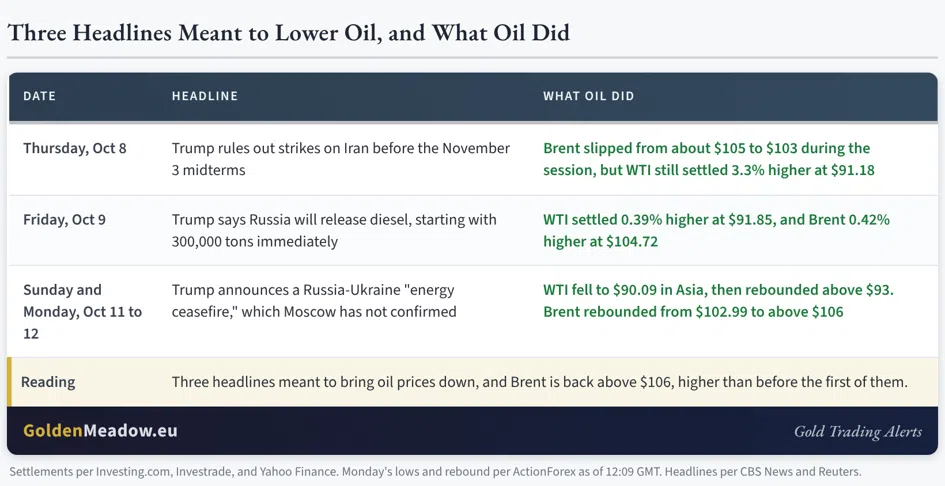
Oil dipped on each of them and recovered each time. The latest one faded within hours: Ukraine's President Zelensky said he learned about the arrangement from media reports, France's President Macron said he had seen no indication that Russia was observing an energy ceasefire over the preceding 48 hours, and Moscow has not confirmed any deal. Brent rebounded from an Asian-session low of $102.99 to above $106, and WTI from $90.09 to above $93.
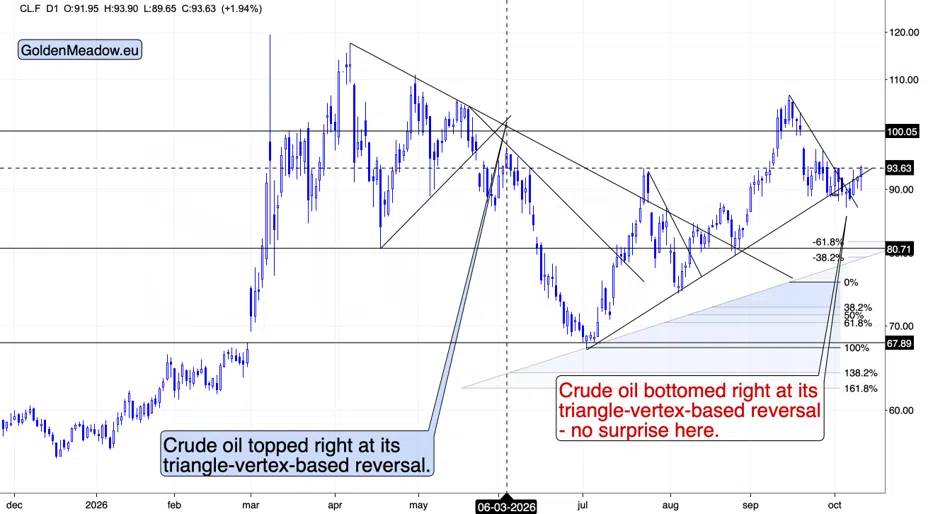
A market that recovers from three rounds of bearish news has buyers underneath it. Higher oil keeps inflation expectations up, which keeps the Fed hiking and the dollar bid, and that is bearish for the precious metals.
How an Energy Ceasefire Would Reach Gold, and Why It Hasn't
The energy ceasefire matters for gold through diesel, not crude. Ukrainian strikes have cut Russian refining, and Russia is a major diesel exporter. If the strikes stop, Russian refineries run harder and export more diesel, and the temporary US waiver of sanctions on Russia's energy sector lets that diesel reach more buyers. That's why diesel reacted first: gasoil futures fell 3 percent in Asian trading after the announcement, twice as much as Brent.
From there, the chain is the one I described on October 6. Diesel moves the trucks, trains, ships, and farm equipment that carry nearly everything, so cheaper diesel lowers the inflation outlook, the long end of the bond market eases, the Fed has less reason to hike, and the dollar loses support. Run in that direction, the oil-rates-USD-gold link is bullish for gold.
It hasn't run in that direction, for three reasons.
First, the ceasefire isn't confirmed. Ukraine's President Zelensky said he learned about it from media reports and accused Russia of striking a power plant in Kharkiv, France's President Macron said he had seen no sign of Russia observing it over the preceding 48 hours, and Moscow has said nothing. A similar announcement in September was never confirmed by either side.
Second, even a real truce works slowly. Damaged refineries take time to repair, and new diesel cargoes take weeks to arrive. The 300,000 tons of Russian diesel the president announced on Friday is about 2.25 million barrels, a fraction of the 100 million barrels the G7 agreed to release.
Third, the diesel shortage isn't only about Russia. The Gulf's refined-product exports haven't recovered from the war, the Houthis are attacking Saudi Arabia, and US diesel still averages $6.28 a gallon, close to the record of $6.53 from September 22. Friday's University of Michigan survey showed five-year inflation expectations rising, not falling.
So, the channel that would help gold is still pointing out the other way: oil is higher, inflation expectations are up, and the dollar is at an 18-month high. The ceasefire would need to be confirmed, show up in diesel prices, and stay there before it changes anything for gold.
Gold: Friday's Gain, Today's Reversal
On Friday, I wrote: "Today's bounce is yesterday's decline in reverse, driven by the same links. The trend didn't reverse with it."
Friday deserves an honest look. Gold rose 1.43 percent on a day when the USD Index closed at an 18-month high of 102.14, the 10-year Treasury yield edged higher, and the University of Michigan's survey showed one-year inflation expectations rising to 4.7 percent from 4.6 percent. Those inputs pointed against gold, and gold rallied anyway. On its own, that counts as resilience, and it's the kind of session I'm watching for.
Today shows the other side. The dollar is up about 0.2 percent, and gold is down more than twice as much, falling more than the dollar is rising. That's the opposite of the bottoming sign. Two sessions, two different answers. The sign that matters has to show up consistently, on the dollar's up days, before it means anything.
On Friday, I also wrote: "The key thing is that this does NOT invalidate the breakdown below the previous head-and-shoulders pattern. The move below $4,000 remains the most likely outcome from here."
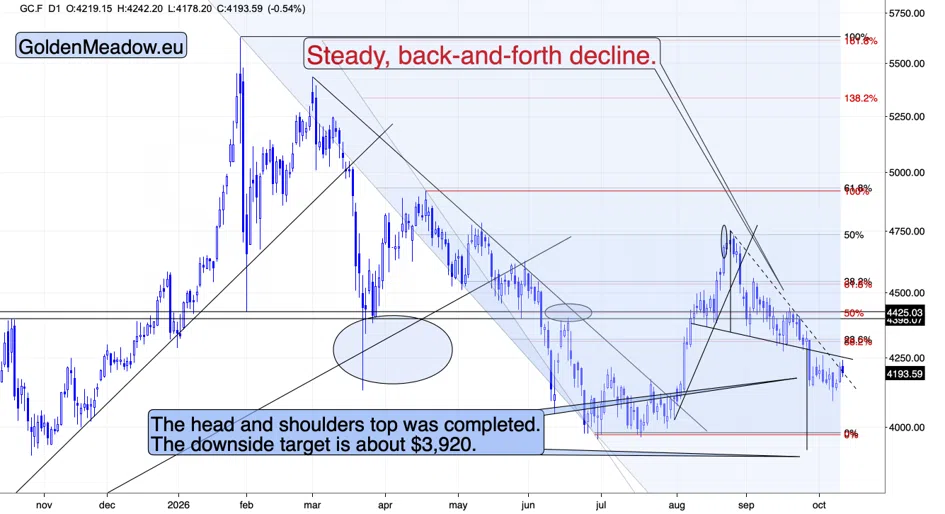
Friday's settlement at $4,216.30 was still below the highs of the verification rebound, $4,251 on September 30 and about $4,239 on October 2.
What’s important is how gold is moving relative to the neckline of the previously broken head-and-shoulders pattern and the declining dashed resistance line. It’s currently below the former, and it’s trading around the latter. I view the previous neckline as more important, but what’s most important here is the situation in the USD Index.
The Dollar
On Friday, I wrote: "Technically, since the consolidation is taking place above the previous 2026 highs, the breakout is fully verified, and the breather's implications are bullish."
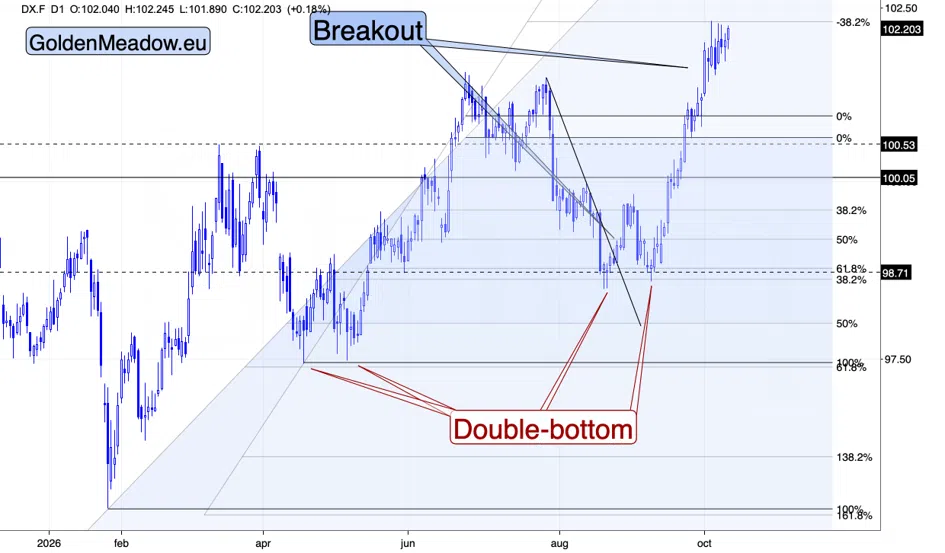
The breather is relatively short so far. The USD Index closed Friday at 102.14, its highest level in about 18 months and its fourth straight weekly gain, and it's trading near 102.4 today, up against all seven major currencies. The euro is near $1.12 after a fifth straight weekly loss.
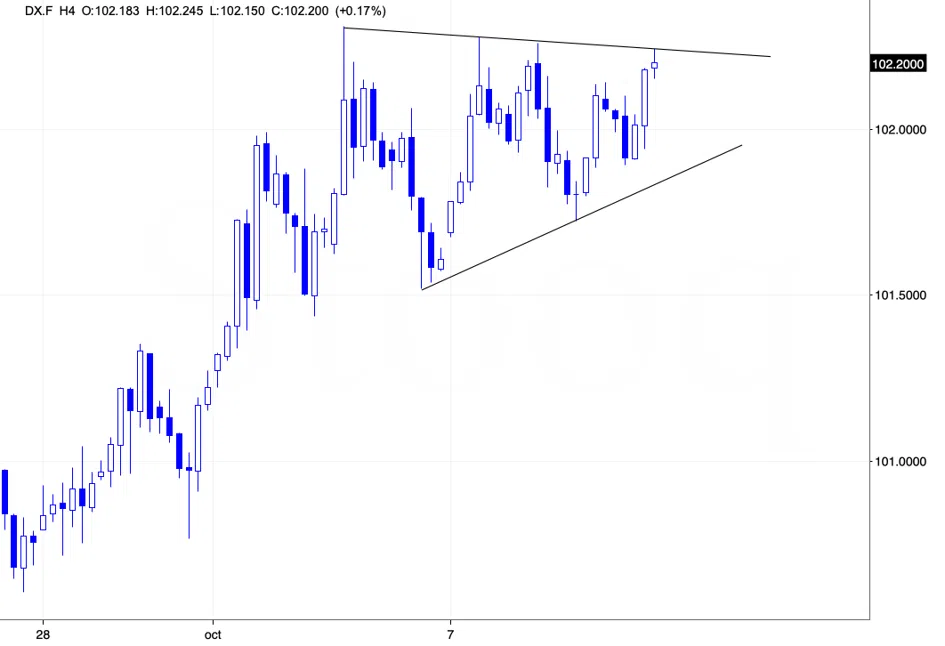
Zooming in reveals that the consolidation is still not over yet – the USD Index is trading between the slightly declining resistance line and the rising support line. As I wrote before – a breakout here can result in a quite significant rally – likely to 105 or so. This would – in turn – likely result in big declines in gold, silver, and mining stocks. Another trigger for such a decline might come from stocks (or they could arrive at the same time, which is even more likely).
Where This Leaves Us
Oil recovered from three headlines designed to push it lower, the dollar resumed its rally from an 18-month high, and gold gave back part of Friday's gain while staying below the highs of its verification rebound. Silver outpaced gold on Friday and is holding up on today's down day for gold, the signature that came before this fall's short-term tops, while the miners are giving back Friday's gains about three times as fast as gold. The war spread to Saudi airports over the weekend, and Tehran says it has stopped responding to Washington.
Three headlines tried to push oil down, and oil is higher. That says more about gold's next move than Friday's rally does.
Thank you for reading the free version of today’s analysis. The premium version (Gold Trading Alert) includes more specific analysis of gold, silver, and mining stocks as well as profit-take levels for our positions. Diamond Members get to enjoy also over ten other premium publications at the fraction of their individual prices. If that might be of interest to you, I invite you to review our premium services. And if you’re not yet on it, I invite you to join our free gold newsletter today.
Thank you.
Sincerely,
Przemysław K. Radomski, CFA