


Crude oil is up about $4 this morning, with WTI above $92 and Brent near $105.
This comes after reports that the White House asked the Pentagon for strike options against Iran before the midterms. Gold fell $46.40 on Wednesday to settle at $4,140.70, with spot gold dipping below $4,100 for the first time since August 5, and it is slightly higher this morning near $4,150. Silver is lower again and trades below $60, and S&P 500 futures are moving back below their August highs.
Three things matter more than the daily moves. Oil confirmed its bottom, the Fed minutes backed another hike, and silver keeps falling about twice as fast as gold. The last one has good reasons behind it, and I'll go through them in detail below, along with the industrial link between silver and stocks.
Oil Confirmed Its Bottom
Yesterday, I wrote: "To be clear – it will be certain that the bottom is in fact in only after the black gold rallies even more. For now, it's already very likely."
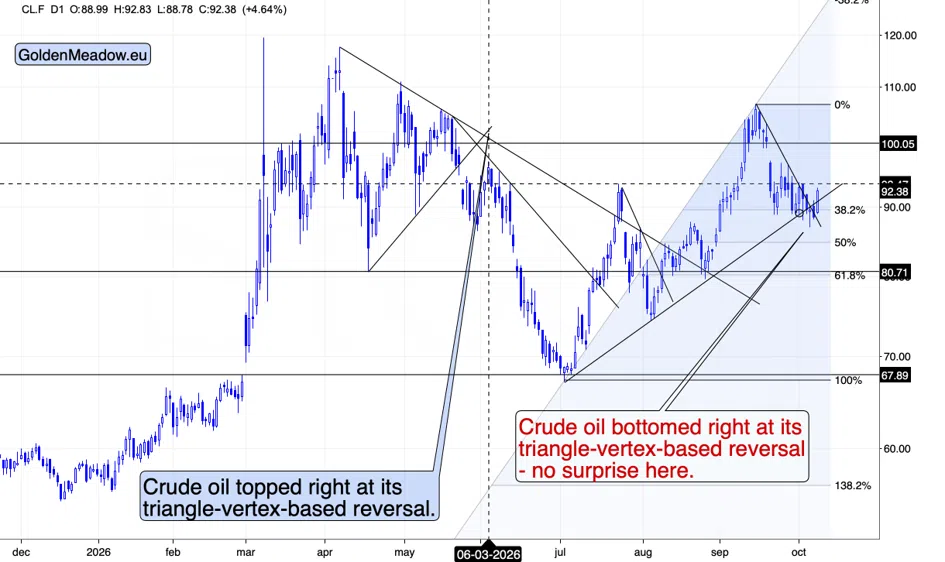
On Wednesday, WTI gave back $1.16 to settle at $88.28 after the International Energy Agency agreed to speed up its emergency stock release and prioritize diesel. Later that day, The Atlantic reported that the White House had asked the Pentagon for strike options against Iran for use before the November 3 midterms. This morning, WTI trades above $92, and Brent topped $105, its highest level in nearly a month. Two more factors added to the move: Houthi missile attacks on Saudi airports, and Isaias, which has already shut in about 500,000 barrels per day of US Gulf production and is expected to reach the northern Gulf Coast as a strong hurricane on Friday.
This morning's rally is the follow-through I was waiting for. Crude bottomed on the exact day the triangle-vertex technique flagged, and in my view, today's move confirms the bottom.
On Monday, I wrote: "Given the oil-rates-USD-gold link, this would be bearish for PMs." The link is working this morning. Treasury futures are lower, which means yields are higher, and the USD Index is slightly higher. Gold has not fallen on it, and in my view, the reason is the same headline that lifted oil.
Gold: A War Bid, Not a Bottoming Sign
On Wednesday, the inputs pointed against gold. The dollar rose about 0.3 percent to near 102.2, and the 10-year and 30-year Treasury yields touched 5.36 percent and 5.73 percent, both the highest since 2002. Oil fell 1.3 percent, which should have helped gold through lower inflation expectations, and it didn't. Gold fell 1.1 percent, more than the dollar rose, which is the opposite of the bottoming sign I described yesterday.
This morning, the inputs point against gold again: oil is sharply higher, yields are up, and the dollar is slightly higher. Gold is slightly higher. On the surface, that looks like the sign I'm waiting for: gold no longer falling on the dollar's up days. The context says otherwise. Gold has a war headline behind it today, safe-haven bids on war headlines have been short-lived for months, and silver, which gets little of that bid, is sliding below $60. The sign I'm watching for is gold holding up on the dollar's up days without a headline to lean on, with silver and the miners holding up too. Today has the headline and none of the confirmation.
Yesterday, I also wrote: "The verification of the breakdown continues, and the next stage of the October sequence is the move toward the first target near $3,920."
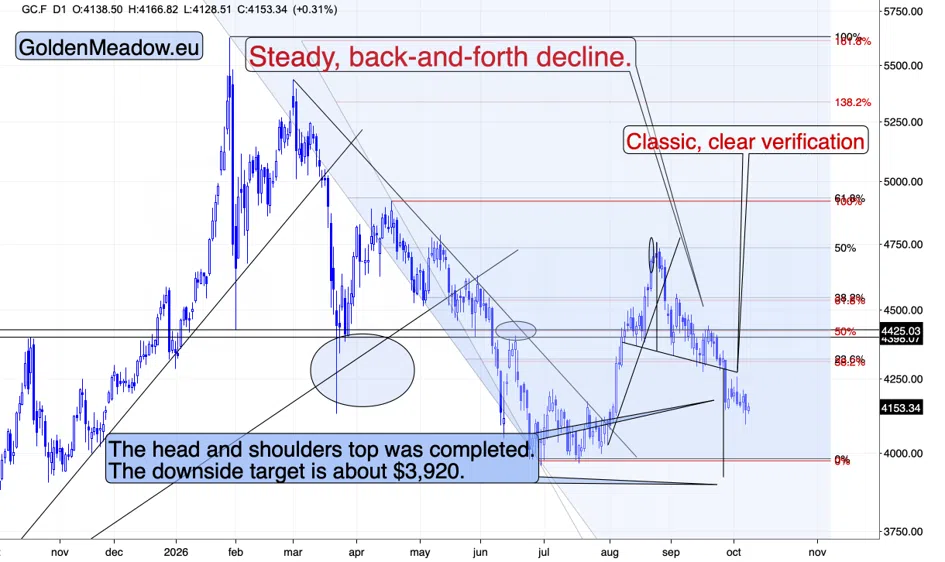
Spot gold's dip below $4,100 on Wednesday took it to its lowest level since early August, and the futures settled at $4,140.70, below Monday's $4,156.80 and Friday's $4,162.30 settlements.
Not much going on in gold, but the head-and-shoulders pattern continues to support a move below $4,000. I told you not to trust the August rally and those who listened are likely happy that they did.
Why Silver Is Falling Twice as Fast as Gold
Yesterday, I wrote: "That is the full sequence: silver outperforms into the short-term top, lags on the next bounce, and then leads the decline."
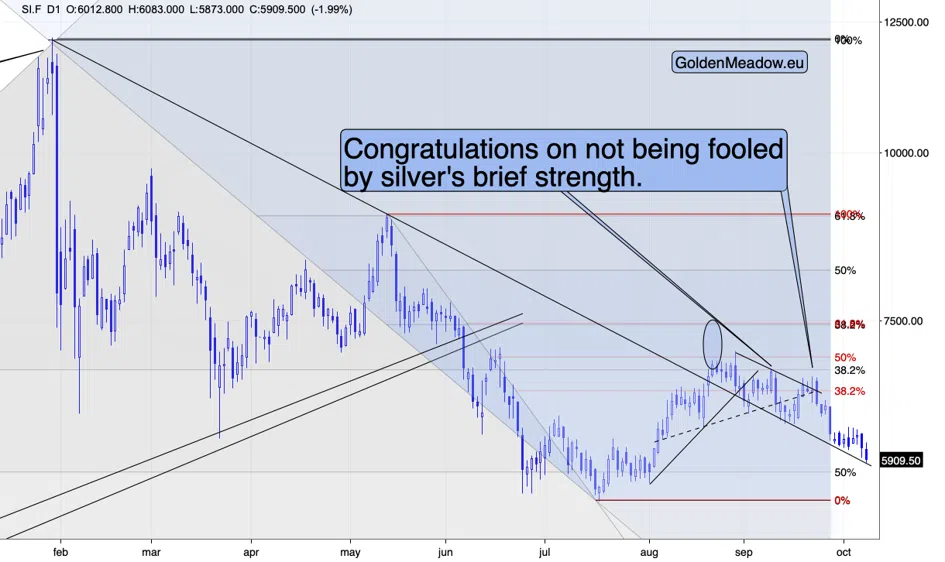
Silver fell below $60 on Wednesday for the first time since early August, and it trades below that level again this morning while gold is slightly higher. Since the January highs, silver has lost about 52 percent and gold about 26 percent. That gap has good explanations, and the first one is history.
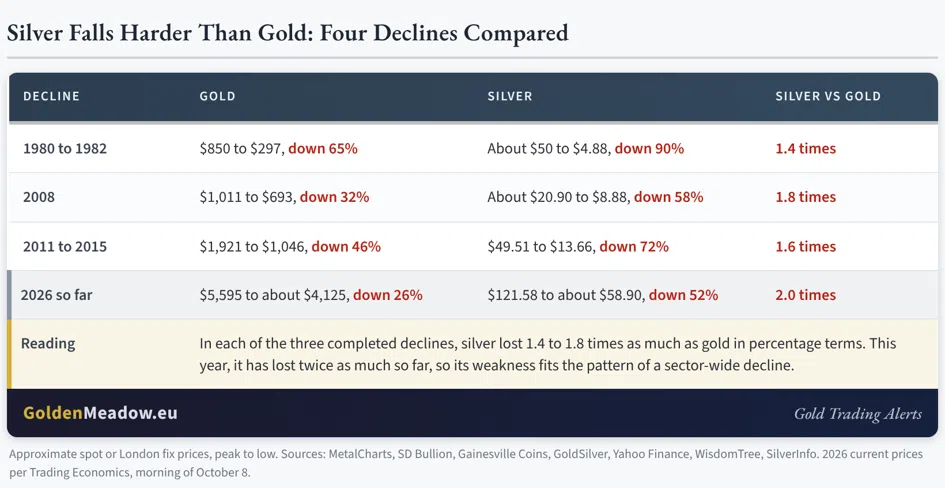
Silver falls harder than gold in every major precious metals decline. In the three completed declines above, it lost 1.4 to 1.8 times as much as gold, and this year's two-to-one gap fits that pattern. Silver is a smaller and more volatile market, and it amplifies gold's moves in both directions.
The second set of reasons is specific to 2026.
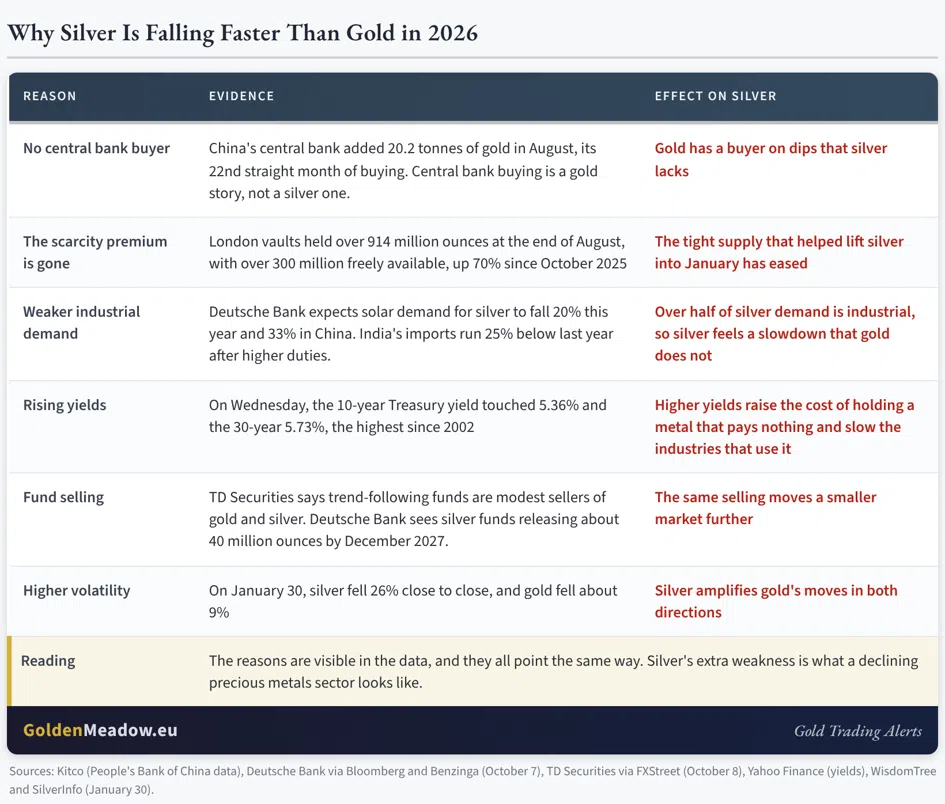
Three of them stand out. First, gold has a buyer that silver lacks: China's central bank added gold for a 22nd straight month in August, and central bank demand is a gold story, not a silver one. Second, the scarcity premium is gone. Deutsche Bank's Daniel Ghali wrote that "peak silver scarcity is clearly in the rear-view mirror," and the premium that tight supply created on the way to January is coming out of the price. Third, higher rates hit silver twice. Like gold, silver pays nothing, so a 10-year yield above 5 percent raises the cost of holding it. Unlike gold, over half of silver's demand is industrial, so the same rates slow the industries that use it.
Today's drop is a single-session move, and there is no new silver-specific news behind it. The main driver is the stock market, and I explain the link in the next section. The decline is also technical. Silver opened at its lowest level since August, below $60, where stop-loss orders and trend-following sell signals cluster, and in a market as small as silver, mechanical selling moves the price further. China's return from its Golden Week holiday did not change that, as spot silver in Shanghai traded at a discount to futures on the first day back. In September, the talk was of metal leaving COMEX vaults and a repeat of last October's squeeze. Instead, registered COMEX inventories rose about 5 percent in the week to October 5, and the squeeze never came.
You'll hear that silver is cheap relative to gold, with the gold-to-silver ratio near 70, up from about 46 at the January highs. A rising ratio is what precious metals declines look like, and 70 is not an extreme. In March 2020, the ratio reached about 127.
On Monday, I wrote: "The move below $50 is now a very likely outcome in my view." Silver's underperformance is the sector-wide decline showing up first where it shows up most, and the move below $50 remains the medium-term outlook.
The Dollar and the Fed Minutes
Yesterday, I wrote: "Minutes that show broad support for another hike would lift the dollar and front-end yields, which is bearish for gold."
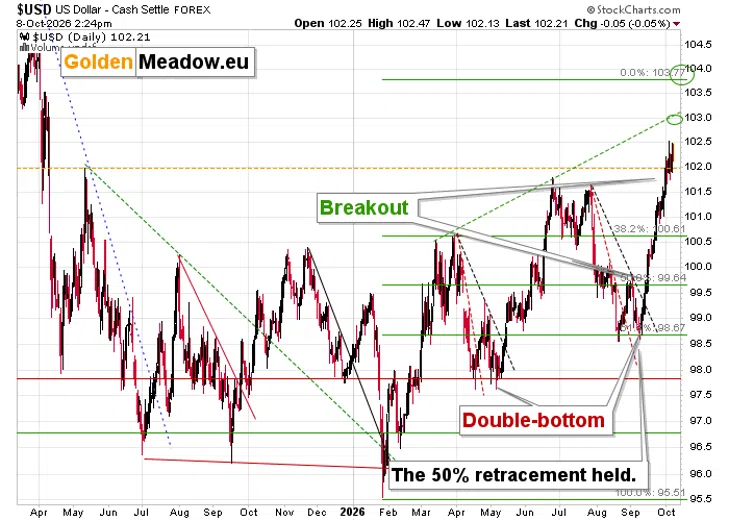
The minutes showed broad support. Most officials judged another hike likely appropriate by the end of the year, and almost all saw the risks to inflation tilted to the upside. Several warned that the AI investment boom might push demand ahead of supply, and a few noted the importance of planning for market stress. The USD Index held its gains after the release, closing near 102.2 with the euro near its 17-month low, and it held up well again this morning. The USD Index keeps soaring in tune with my previous forecasts.
On Wednesday, Governor Waller said: "I anticipate additional hikes to support a timelier return of inflation to our 2% goal," adding that "there is some flexibility about when those hikes will occur." Markets price less than a 20 percent chance of a hike on October 28 and about an 80 percent chance of at least one by December. This morning's jobless claims came in at 197,000, slightly below the 200,000 expected, which leaves the case for another hike intact.
The Treasury also sold $39 billion of 10-year notes at 5.300 percent, the highest yield at a 10-year auction since November 2000, and demand was strong. The 10-year yield backed off from 5.36 percent and closed near 5.28 percent. A 10-year Treasury paying 5.3 percent is the competition gold faces, and on Wednesday buyers lined up for it.
Where This Leaves Us
Crude oil confirmed its vertex bottom with a rally above $92, the Fed minutes showed broad support for another hike, and the 10-year auction cleared at the highest yield since 2000. Gold fell to its lowest level since early August on Wednesday and is holding up today only with a war headline behind it. Silver is falling about twice as fast as gold, as it did in every major precious metals decline before this one, and today it is following stocks lower as S&P 500 futures move back below their August highs.
Gold has a war headline to lean on today. Silver shows what the metals do without one.
Thank you for reading the free version of today’s analysis. The premium version (Gold Trading Alert) includes more specific analysis of gold, silver, and mining stocks as well as profit-take levels for our positions. Diamond Members get to enjoy also over ten other premium publications at the fraction of their individual prices. If that might be of interest to you, I invite you to review our premium services.
Thank you.
Sincerely,
Przemysław K. Radomski, CFA