


On Monday, the ISM's services index came in at 54.9, in line with expectations, while its price rose to 74 from 72.6.
The 10-, 20-, and 30-year Treasury yields all set new 52-week highs, with the 10-year near 5.31 percent and the 30-year near 5.66 percent, a 24-year high. The USD Index rose 0.3 percent. Gold gave up an early gain to near $4,196 and settled $5.50 lower at $4,156.80, while silver rose $0.88 to $61.30. The Nasdaq closed at a record.
Technically, little is happening in gold, silver, and the miners. The key event is in the currency market: Monday was the USD Index's third straight close above its previous 2026 highs, which confirms the breakout. This morning the index is only slightly lower, crude oil is down about 1.5 percent and trading below its late-September low, Treasury yields are slightly lower, and gold is up about $23 near $4,180. Today is also the day the triangle-vertex technique flagged for crude oil, so the dollar and oil are where today's analysis focuses.
The Key Event: The Dollar's Breakout Is Confirmed
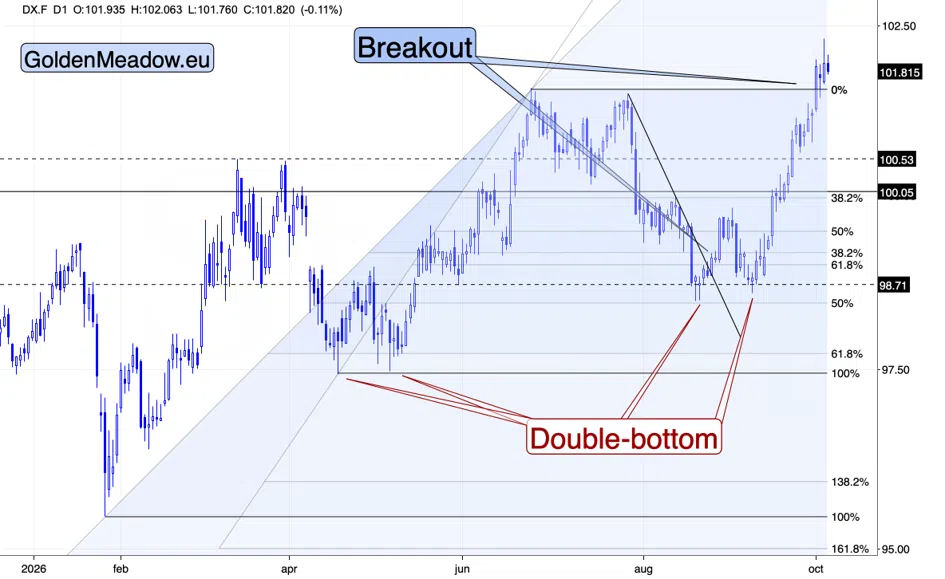
On September 10, I wrote: "It seems that the double-bottom in the USD Index is in, and please note that this is exactly how it bottomed in May below 98. The implications are bullish for the USD Index and bearish for the precious metals sector."
Yesterday, I wrote: "Technically, the USD Index soared above its May 2025 high and is now verifying this breakout. Gold might slide once it's clear that the USD Index held its ground."
It is clear now.
Monday's close was the third straight daily close above the previous 2026 highs, which confirms the breakout. The index rose 0.3 percent on Monday, with dollar-yen back above 158, and it is holding near 101.8 this morning, only slightly lower despite cheaper oil and lower yields. The double bottom that formed at the August and September lows, the same shape as the spring bottom, has produced the move it implied: a rally from below 99 to new 2026 highs in about four weeks.
The confirmation came in the same week that the odds of an October hike fell from about 70 percent to about 20 or less. The dollar did not need a more hawkish Fed to break out. It had the long end of the bond market and the euro's problems, and both are still in place.
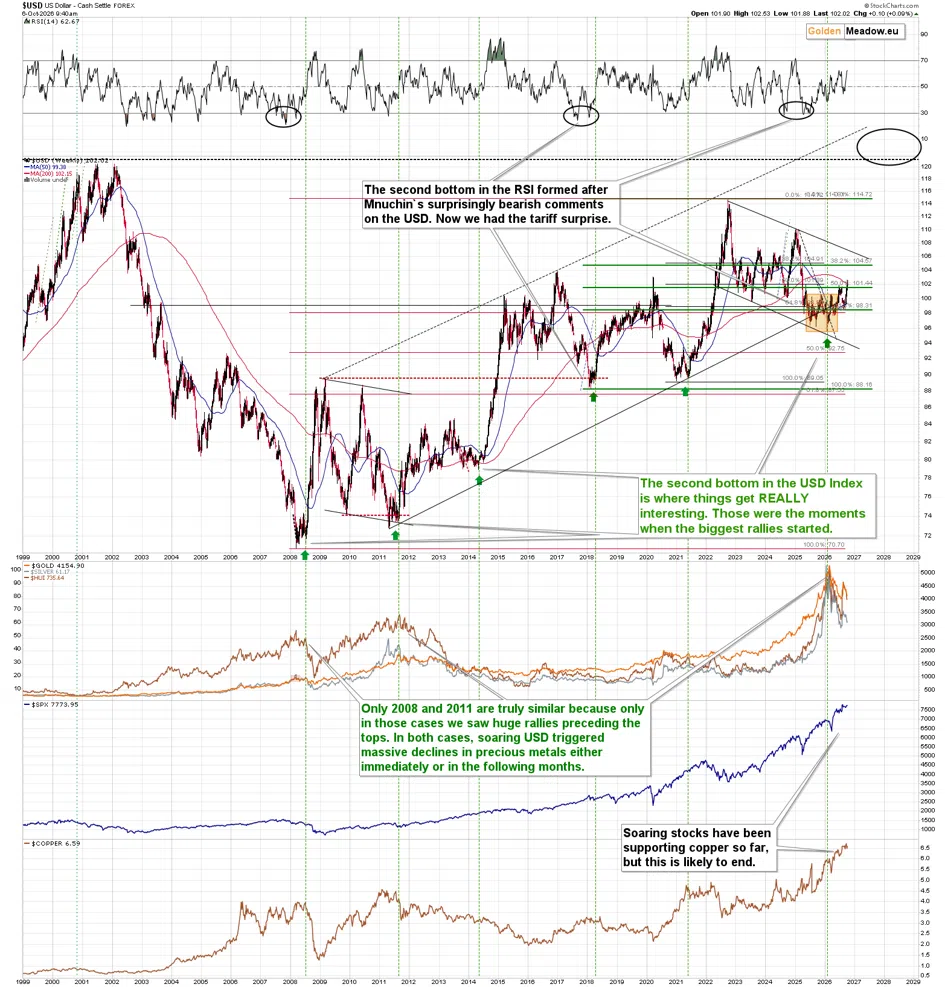
From the medium-term point of view, the rally is still small compared with the multi-year base I described on September 24, and the implications for the precious metals sector are the ones I described on September 10. The USD Index soars in perfect tune with my previous analyses.
Oil's Vertex Day
The other market where something is happening today is crude oil. Yesterday, I wrote: "Technically speaking, crude oil is once again testing the previous lows and the rising, medium-term support line." And: "This would be a good moment (based on the triangle-vertex-based technique) for crude oil to end this broad bottom and rally. Given the oil-rates-USD-gold link, this would be bearish for PMs."
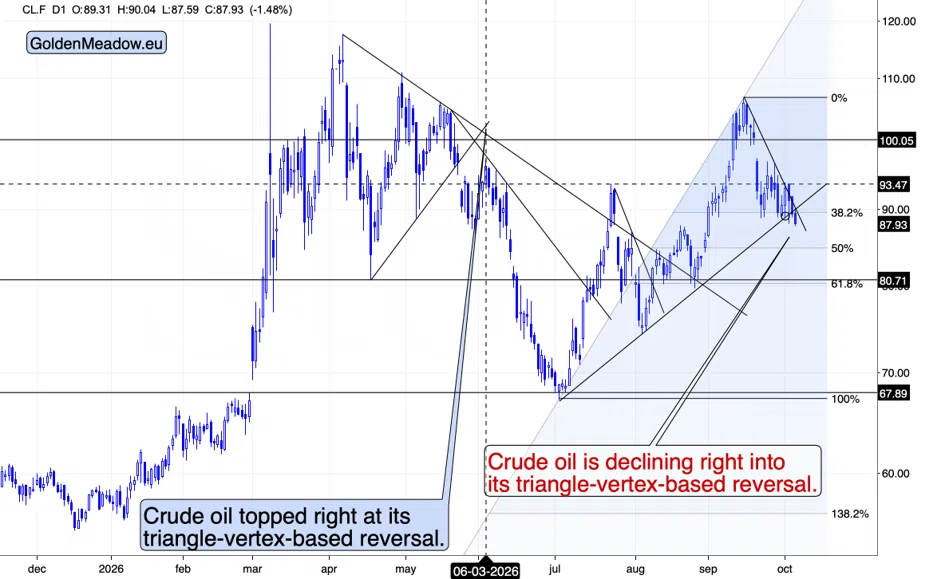
WTI touched $87.59 this morning and trades near $87.90, below its late-September low of $88.58. Crude oil is declining right into its triangle-vertex-based reversal. The direction of the move into the vertex decides what kind of reversal to expect: a rally into the vertex points to a top, and a decline into it points to a bottom. In early June, crude rallied into its vertex and topped there, starting the decline into July. Today, it is declining into one, which means the reversal has bullish implications for crude oil.
The fundamentals explain why crude has slid into the vertex instead of bouncing earlier. Most of the news on the supply side has been bearish for oil, and the war news has not been enough to offset it.
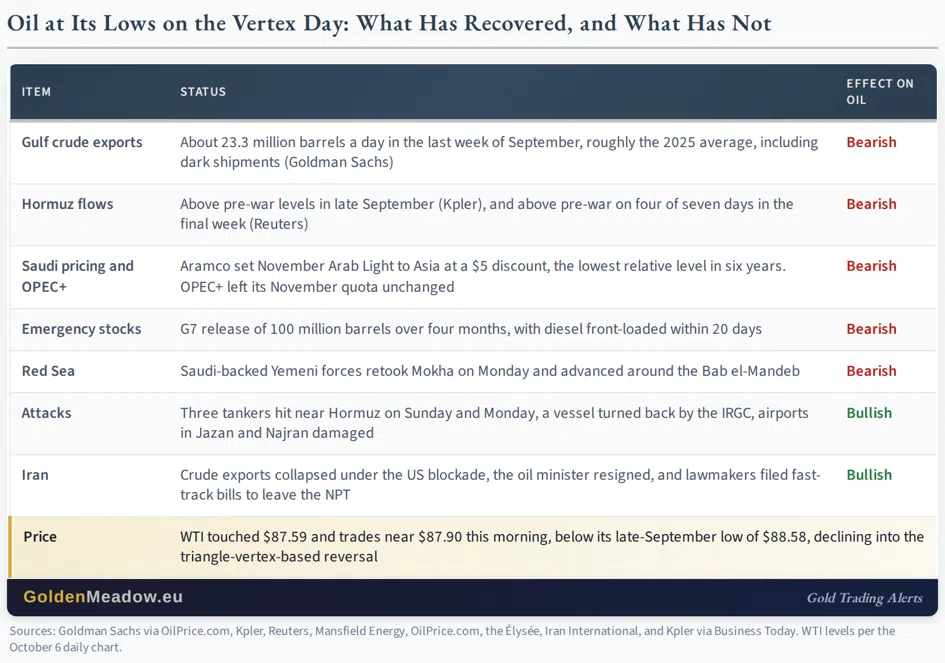
The link to gold runs through the bond market.
Lower oil eases inflation expectations, which pulls long-term yields down and takes some pressure off gold. That is the channel behind gold's gain this morning.
If crude reverses higher from here, the same channel runs the other way, and that is why a bottom in oil matters more to gold than any headline from Tehran. There is one catch on that channel, and it explains why the long end keeps rising even with crude near its lows.
Crude Is Not Diesel
The table above is about crude oil. The part of the oil market that matters most for inflation, and therefore for gold, is diesel, and diesel tells a different story.
Crude is a raw material. Diesel is what refineries make from it, and its price is the cost of the crude plus the refiner's margin, called the crack spread. When crude is plentiful but refining capacity is short, that margin widens, and diesel stays expensive while crude falls. That is this fall's oil market. Gulf crude exports are back near normal, but the region's refined-product exports have not recovered the same way, Ukrainian strikes have cut Russian refining, US refiners were already running hard, and October brings refinery maintenance and harvest-season demand. US distillate inventories fell to their lowest seasonal level on record in September.
The numbers show it. The US diesel crack spread rose above $100 a barrel for the first time in September. AAA's national average for diesel hit a record $6.53 a gallon on September 22 and was still $6.32 on Monday, about two-thirds higher than a year ago, with WTI near $90. The G7's release, which front-loads diesel in its first 20 days, has already pulled the European diesel margin down from about $85 a barrel to about $70. ING's head of commodities strategy notes that margins remain historically high and that the lasting fix is refined products flowing from the Gulf again. The EIA expects US diesel margins to stay above $2 a gallon through November.
Here is why this matters for gold. Diesel moves the trucks, trains, ships, and farm equipment that carry nearly everything, so it reaches the CPI through the prices of goods and services long after crude makes the headlines. It is in the 24.1 percent monthly jump in diesel producer prices in August, in the ISM's prices index for manufacturers at 77.9, and in the prices index for services at 74. That is the inflation risk the long end of the bond market is charging for, and it is why the 10- and 30-year yields set new highs on Monday while crude fell.
The takeaway: when crude falls, check diesel before concluding that inflation pressure is easing. If crude bottoms here, as the vertex suggests it might, it will rise from a level at which diesel never got cheap, and the long end will have one more reason to stay high. And for the situation to continue to develop in line with my October and September forecasts for gold.
Thank you for reading the free version of today’s analysis. The premium version (Gold Trading Alert) includes more specific analysis of gold, silver, and mining stocks as well as profit-take levels for our positions. Diamond Members get to enjoy also over ten other premium publications at a fraction of their individual prices. If that might be of interest to you, I invite you to review our premium services.
Thank you.
Sincerely,
Przemysław K. Radomski, CFA