


Oil crashed. Gold surged. Silver surged even more. The channel reversed on the most significant diplomatic development since the war began.
Then, oil reversed. It’s up for the day at the moment of writing these words.
The USD Index erased its intraday decline, and mining stocks already gave away most of their daily gain.
The recovery in crude oil is key – everything else is likely to follow.
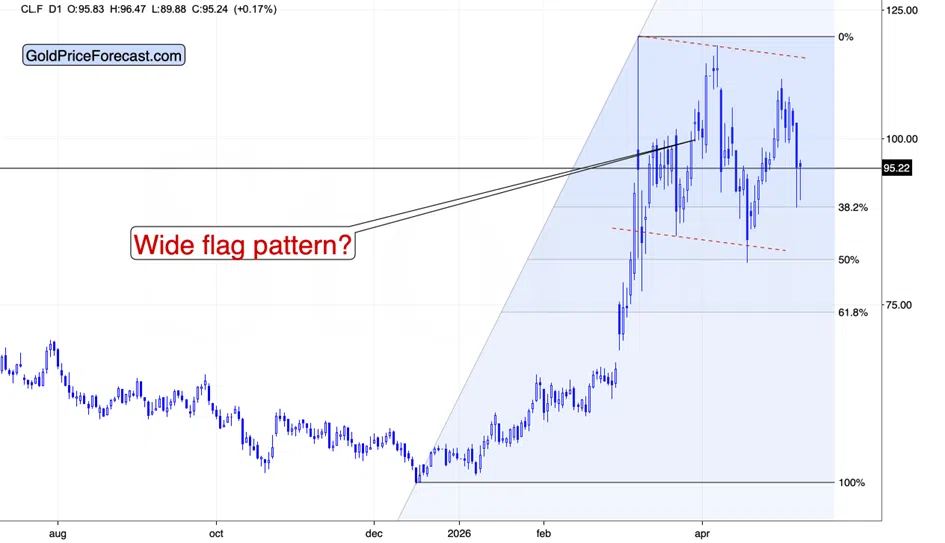
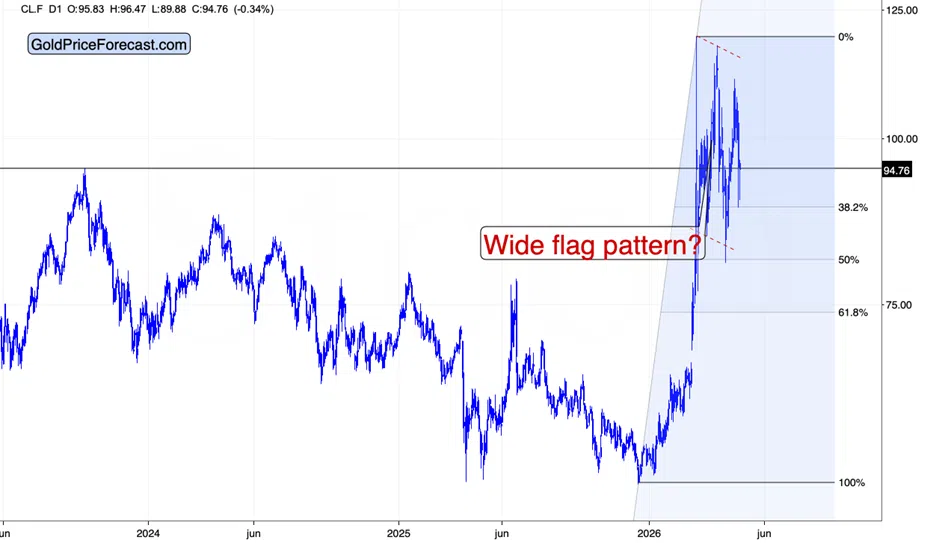
Crude oil declined once again below its 2023 high, and it touched its 38.2% Fibonacci retracement, only to rally back up. At the moment of writing these words, oil is slightly up for the day.
Remember how the 2023 high served as resistance in early March?
It now provides support.
What used to be “too high” is now “too low”.
It seems that the market is getting some grip on reality instead of reading encouraging headlines through pink glasses.
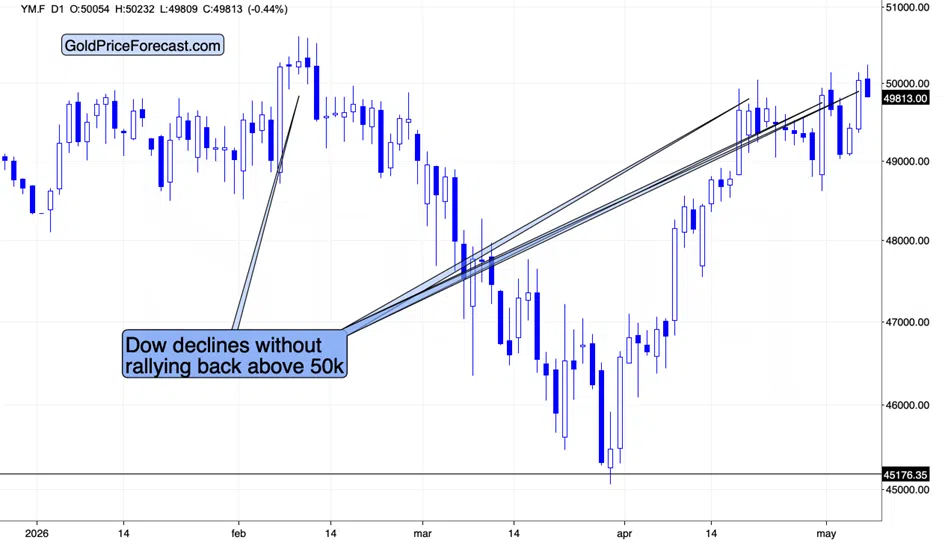
Dow futures just invalidated their move above the all-important 50k level once again.
Is this the top? It could be. And if it isn’t, stocks are likely to rally just a little more (perhaps taking some markets with them) before they finally collapse.
The Fundamental Support for the Technicals
Axios reported that the US and Iran are "closing in" on a one-page, 14-point memorandum of understanding (MoU) to end the war. Two US officials and two other sources confirmed it. A Pakistani mediator told Reuters: "We will close this very soon. We are getting close." The US expects Iranian responses within 48 hours.
This is real. The document exists. The terms are substantive. But the market is treating the MoU as a deal. It's not. It's a framework to negotiate a deal, with the hardest questions deferred to future talks that may or may not succeed. The fine print tells a very different story than the headlines.
What the MoU Actually Says
The reported terms: declare an end to the war, start a 30-day negotiation period, Iran commits to a moratorium on enrichment (duration unresolved), Iran pledges to never seek a nuclear weapon, enhanced UN inspections including snap inspections, both sides "gradually lift" Strait and blockade restrictions during the 30-day period, US gradually lifts sanctions and releases frozen funds.
If negotiations collapse during the 30 days, the US can restore the blockade or resume the war.
What the MoU Doesn't Resolve
The enrichment moratorium gap is enormous. Iran proposed 5 years. The US wants 20. Sources speculate 12-15 years as a "compromise." That's speculation, not agreement. The duration is "being actively negotiated."
Iran's existing stockpile of 400+ kg of uranium enriched to near weapons grade is not addressed. Two Axios sources claimed Iran would agree to remove its highly enriched uranium from the country. Reuters' version of the story did not mention the stockpile at all. That's the immediate proliferation risk, and it's either unresolved or disputed between sources.
Iran's missile program: not mentioned. Iran's support for proxy militias: not mentioned. These were core US demands for months. Their absence from the MoU either means the US dropped them (a major concession) or they're being deferred to the 30-day talks (where they'll create more friction).
The Strait Question Nobody is Asking
The most important gap is the one the market isn't seeing.
The MoU says "both sides lifting restrictions around transit through the Strait of Hormuz" during the 30-day period. Iran lifts its shipping controls. The US lifts its blockade. Gradually, not immediately.
But what happens to the Strait permanently?
Iran's Deputy Speaker said last week, citing a direct order from Supreme Leader Khamenei, that the Strait will "under no circumstances" return to its previous state. Iran's parliament is drafting permanent Strait control legislation: banning Israeli-linked ships, restricting "hostile states," and imposing rial-denominated tolls. Araghchi said weeks ago: "We intend to devise a new arrangement to ensure secure maritime traffic through the waterway." The House of Commons Library research briefing explicitly noted that "Iranian control was not the case beforehand."
So the MoU says "ease restrictions during the 30-day period." Iran's own government says "the Strait never goes back to how it was before." Those two positions are not compatible. The MoU kicks the permanent Strait question into the 30-day negotiations, where Iran's starting position is permanent control under new arrangements, and the US starting position is full restoration of free navigation. That's not a small gap to bridge in 30 days. That's the entire war in miniature.
And even if Araghchi and Ghalibaf agree to something on paper, the IRGC physically controls the Strait. Mines are in the water.. Vahidi and his commanders decide what passes through. The same structural problem that killed the April 17 reopening in 18 hours applies to any MoU implementation. The men at the table can sign. The men with the guns implement. We've seen what happens when those two groups disagree.
China Won't Deliver Iran for Free
Araghchi met Wang Yi in Beijing today. The mainstream framing: China pressures Iran to open the Strait and accept the deal. Rubio said publicly: "I hope the Chinese tell him what he needs to be told."
I think this misreads China's actual incentives.
The US is bogged down with 34% approval and $4.46 gas. Every week the war continues, it weakens Washington politically and economically. A distracted US is less capable of pressuring China on Taiwan, the South China Sea, or trade. From Beijing's perspective, America's struggle is not a problem to solve. It's a leverage to use. But I already wrote about that yesterday.
Israel Just Bombed Beirut
While the MoU negotiations proceed, Israel struck Beirut's southern suburbs on Wednesday for the first time since the ceasefire, killing Hezbollah Radwan Force commander Ahmad Ali Balout. Netanyahu personally ordered it. The IDF says it has killed 220+ Hezbollah fighters since the ceasefire began, 85 in the past week alone. 13 people were killed across Lebanon on Wednesday.
This matters for the MoU because Iran has repeatedly linked the Strait to Lebanon. Bombing Beirut during a ceasefire gives Iran's hardliners (and the IRGC specifically) the argument that the US and Israel can't be trusted to honor agreements. If you're Vahidi, sitting on the IRGC's Strait assets, watching Israel assassinate Hezbollah commanders during a ceasefire, how eager are you to pull your gunboats back based on a one-page document?
The Pattern
I've been tracking TACO rallies for two months. April 17: Strait "reopened," oil crashed, reversed in 18 hours. April 22: ceasefire extended, gold bounced, faded within days. May 1: "Iran responded to amendments," oil crashed, Trump called the proposal "not acceptable" days later. May 5: Project Freedom paused, "great progress," oil crashed.
Each time the market overplayed the positives. Each time the structural reality reasserted.
This MoU is qualitatively different from previous cycles. There's an actual document. There are specific terms. The US is offering sanctions relief and frozen funds. The probability of an eventual deal has risen. I'd put it at 30-35%, up from 15-20% before this week. The market seems to think that it’s over 70%.
But 30-35% is not 70%. And even if the MoU is signed, it starts 30 days of negotiations on the hardest questions (enrichment duration, Strait permanent status, IRGC compliance). The Strait doesn't reopen overnight. Mine clearance takes six months. The structural inflation damage (core PCE at 4.3% quarterly, with Oxford Economics saying the passthrough peaks in late May/early June) is already done. The Fed is still frozen.
The trends in precious metals and non-energy commodities remain down. Today's corrective bounce, while significant, keeps gold well below the $4,800 level it broke below weeks ago. Silver's 6.5% surge fits the pattern of relative strength vs. gold on an immediate basis. The underlying picture hasn't changed. The market is pricing a deal that doesn't exist yet, based on a framework that defers the hardest questions, negotiated with a government whose military doesn't answer to its diplomats, while Israel bombs the capital of Iran's closest ally.
The analysis continues in its premium version, with clear profit-take levels for all featured trades. Interested? Get details in today’s Gold Trading Alert now.
Thank you.
Sincerely,
Przemyslaw K. Radomski, CFA